Compact Skid Steer Productivity Guide: Cycle Time, Attachment Changes, Crew Planning, and Job Estimating
A compact skid steer can look simple from the outside: a small power unit, a loader arm, and an attachment mounted at the front. In practice, getting dependable results from the machine requires a much more complete understanding of improving compact skid steer productivity without sacrificing machine life or job quality. The operator and owner must think about access, traction, hydraulic demand, load position, attachment geometry, machine stability, ground conditions, transport, and service requirements at the same time. That is why reducing nonproductive travel, poor staging, unnecessary attachment changes, waiting time, and inefficient work cycles matters on real jobsites. A machine that is technically powerful can still be slow, expensive, or difficult to control when it is poorly matched to the task. Conversely, a properly selected compact machine can replace a surprising amount of hand labor while working in spaces that larger loaders cannot reach. This guide explains the subject from a practical jobsite perspective. It focuses on the decisions that affect performance, safety, productivity, and ownership cost, with examples drawn from common work such as landscape installation, small excavation, material handling, site cleanup, and rental fleet planning. Specifications vary by manufacturer and model, so always use the operator manual, attachment instructions, and rated-capacity information for the exact machine in use.
The central lesson is that improving compact skid steer productivity without sacrificing machine life or job quality should be managed as a combination of machine capability, attachment matching, operator technique, site planning, and maintenance. The most useful specifications are cycle time, travel distance, attachment change time, and loads per hour, but numbers alone do not determine jobsite success. A well-matched compact skid steer with a skilled operator can complete landscape installation, small excavation, material handling, site cleanup, and rental fleet planning efficiently while minimizing hand labor and unnecessary machine movement. Build the work around stable loads, clean hydraulic connections, smooth controls, appropriate traction, and a clear travel path. Inspect daily readiness, fuel planning, spare wear parts, and attachment inspection before small issues become failures. Most importantly, use the instructions and limits for the exact machine and attachment. That approach improves safety, extends component life, and makes the compact skid steer a dependable part of the equipment fleet rather than simply a convenient machine to have on site.
Collection Summary
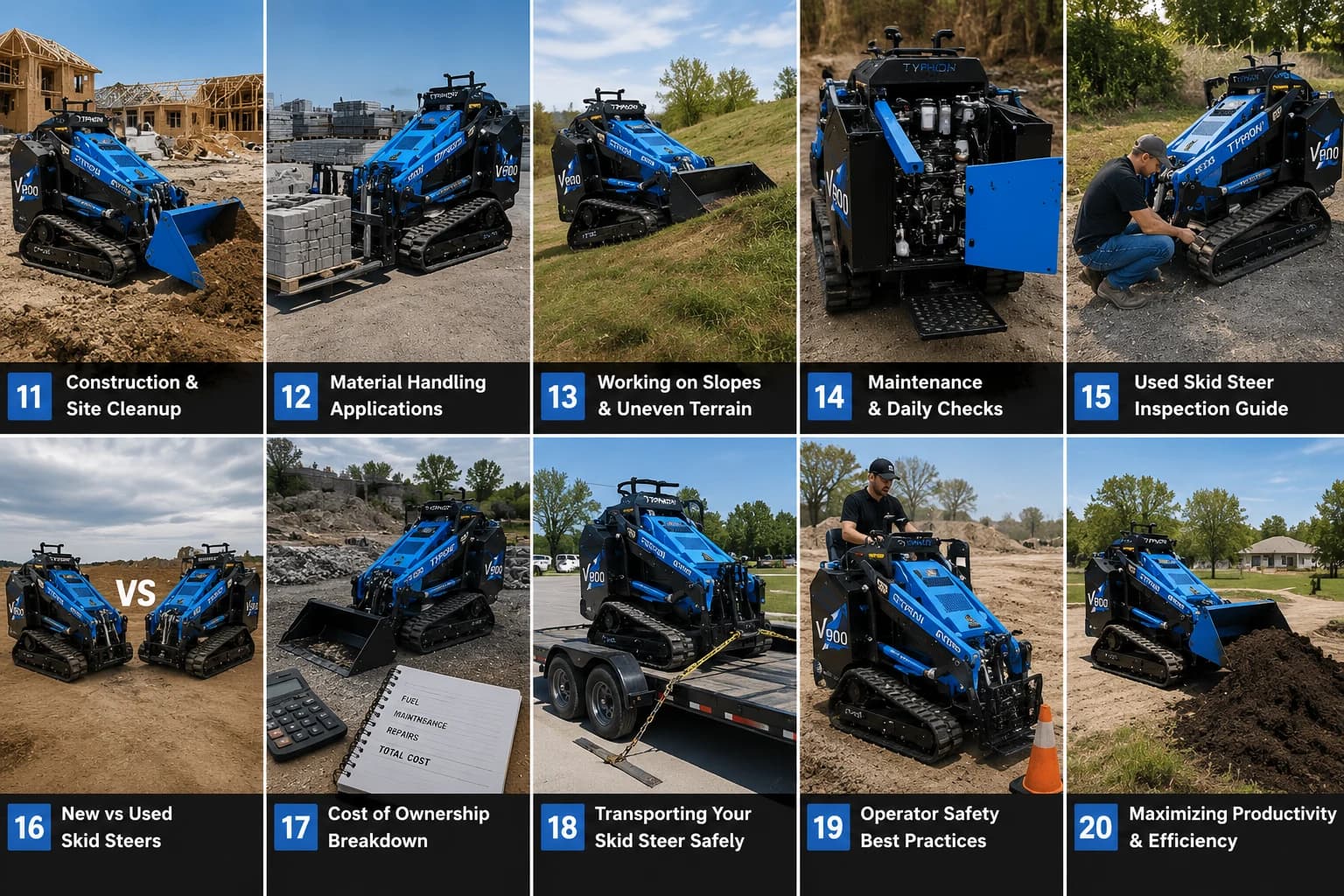
Total guide articles: 20
Combined approximate word count: 74,331
Shortest article: 3,664 words
Longest article: 3,760 words
Editorial Note
These guides are written as general educational content for compact skid steer owners, buyers, operators, contractors, and equipment websites. Model-specific ratings and procedures can differ. For publishing, pair each guide with the exact specifications, images, and manufacturer instructions that apply to the equipment being discussed.
Understanding the Core Concept
The most useful way to understand improving compact skid steer productivity without sacrificing machine life or job quality is to treat the skid steer as a complete work system rather than a stand-alone machine. The engine creates mechanical power, the hydraulic system converts a large portion of that power into controlled movement, the drive system turns that energy into traction, and the loader linkage or auxiliary circuit transfers it to the attachment. At the same time, the weight of the machine provides the counterbalance that makes lifting, digging, pushing, and carrying possible. Every improvement in one area creates a limit somewhere else. A heavier attachment may be stronger but reduces the useful payload. More hydraulic flow can make a powered tool faster, but only if the attachment accepts that flow and the cooling system can control heat. More aggressive traction can improve pushing force yet increase surface damage during tight turns. Good operation therefore depends on balance. The goal is not to maximize every specification; it is to create a combination that performs the required work predictably. On a typical day, the machine may move among landscape installation, small excavation, material handling, site cleanup, and rental fleet planning, so the operator should understand how each task changes the load on the hydraulic system, the undercarriage or tires, and the machine's center of gravity.
Compact machines are especially sensitive to setup because their working envelope is intentionally small. A few inches of width can determine whether a machine can pass a gate. A few hundred pounds of attachment weight can materially change stability. A small change in bucket angle can determine whether the cutting edge slices cleanly or rides over hard soil. For that reason, experienced operators build repeatable habits: they approach work squarely, keep loads low during travel, make smooth control inputs, and reposition the machine rather than forcing the attachment from a poor angle. They also watch the machine's feedback. Engine note, hydraulic sound, tire spin, track slip, heat, and attachment speed all indicate whether the machine is operating efficiently. When those signals change, the right response is normally to reduce load or adjust technique instead of simply adding throttle. This systems view is the foundation for every other section of the guide.
Key Specifications and What They Really Mean
The specifications most relevant to this topic include cycle time, travel distance, attachment change time, loads per hour, fuel per productive hour, and crew waiting time. These numbers should never be read independently. Cycle time is useful only when the attachment weight, load position, and operating surface are also considered. Travel distance influences transport, ground pressure, and the amount of counterweight available to resist tipping. Attachment change time affects how quickly hydraulic functions can move or how strongly an attachment can be powered, while loads per hour may determine compatibility or sustained performance. Dimensions such as fuel per productive hour and crew waiting time can be just as important as power because they determine access and whether the machine can place material where the job requires it. Buyers should build a short list of minimum requirements before comparing models. Doing this prevents the common mistake of choosing the machine with the biggest headline number while missing a smaller specification that actually controls the job.
A useful comparison method is to write down the heaviest expected material or attachment, the narrowest access point, the highest loading or dumping point, the softest ground condition, and the longest period of continuous hydraulic work. Then compare each candidate machine against those real conditions. If the job is dominated by landscape installation and small excavation, maneuverability and precise control may be more important than maximum travel speed. If the machine will spend hours on rental fleet planning, hydraulic cooling and attachment compatibility may deserve more weight. Also remember that brochure values are usually measured under defined test conditions. Real jobs introduce slopes, uneven ground, partially filled buckets, attachments that extend the load forward, and operators with different experience levels. A responsible selection leaves operating margin rather than planning to work at a rated limit during every cycle.
Major Components and How They Affect Performance
Several components directly influence improving compact skid steer productivity without sacrificing machine life or job quality: machine, primary attachments, support truck or trailer, material staging area, operator, and jobsite access routes. The machine determines available power and must stay clean and cool. The primary attachments determines how smoothly power reaches the ground or attachment. The support truck or trailer controls the lifting path and affects reach, breakout, and load stability. The material staging area is especially important when the machine operates powered tools, because hose routing, coupler condition, pressure, and flow all influence attachment behavior. The operator must lock positively because every bucket, fork, trencher, auger, or specialty tool depends on that connection. Finally, the jobsite access routes determines how comfortably and accurately the operator can control the machine over a long workday.
Component condition can change performance long before a warning light appears. Worn pins can create enough movement to make finish grading difficult. Dirty cooling screens can cause hydraulic and engine temperatures to rise during continuous attachment work. Loose or damaged quick-attach parts can let an attachment shift under load. A weak battery or corroded electrical connector can create intermittent control faults that are difficult to diagnose. Small machines also tend to work close to soil, mulch, dust, and debris, so cleaning is not cosmetic maintenance; it protects cooling airflow and helps the operator see leaks early. When evaluating a machine, look beyond paint and hours. Check how the components are packaged, how easy they are to inspect, and whether normal service can be completed without removing unnecessary panels or attachments.
Planning the Job Before the Machine Starts
Before starting work, plan around break the job into operations, stage materials close to use, select the right primary attachment, plan travel paths, combine compatible tasks, measure cycle time, and adjust the process before pushing machine speed. The sequence begins with the worksite, not the ignition key. Identify people, structures, buried or overhead utilities, soft shoulders, slopes, traffic routes, and the intended place for spoil or material. Decide where the machine will enter and exit. Confirm that the attachment is appropriate for the material and that it is within the machine's mounting, hydraulic, and capacity limits. If the task involves repeated loading, shorten the route between the pile and destination. If the task involves precision work, establish reference points before disturbing the surface. If multiple crews share the site, agree on travel lanes and communication signals. A compact skid steer is maneuverable enough to enter crowded areas, which makes planning even more important because the operator can quickly move into spaces occupied by workers, tools, trucks, or finished surfaces.
Good planning also reduces attachment changes. A common efficiency loss occurs when the operator switches tools repeatedly because the work was not sequenced. It is often faster to finish all bulk material movement with one attachment, then complete trenching or drilling, and leave finish grading for the final phase. The exact sequence depends on the project, but the principle is consistent: minimize nonproductive movement and avoid driving over completed work. Stage fuel, grease, spare teeth, cutting edges, and frequently used tools near the support vehicle so small problems do not stop production. Planning should also include a shutdown location that is level, secure, and clear of traffic. These details can save more time than trying to work faster during the actual cycle.
Step-by-Step Operating Approach
A disciplined operating sequence for this topic can follow seven basic stages: break the job into operations, stage materials close to use, select the right primary attachment, plan travel paths, combine compatible tasks, measure cycle time, and adjust the process before pushing machine speed. Begin slowly and verify control response before placing the attachment under full load. Approach the work squarely whenever possible. Use engine speed that provides stable hydraulic response without creating unnecessary noise or heat. When loading, let the attachment geometry do the work instead of relying on wheel or track spin. When carrying, keep the load close to the ground and avoid sudden direction changes. When dumping or placing, stop on firm ground before raising the load unless the machine's instructions and job conditions clearly permit otherwise. When using a powered attachment, engage hydraulics at low load, listen for abnormal noise, and increase demand gradually.
Smoothness is one of the clearest signs of an efficient operator. Abrupt joystick movements throw material out of the bucket, increase tire or track scrub, shock pins and bushings, and make the machine less stable. Smooth movements keep traction available and make it easier to judge when the attachment is overloaded. The operator should also separate travel from fine attachment control when precision matters. Instead of trying to steer, lift, tilt, and crowd simultaneously in a tight area, stop or slow the machine and make one controlled correction. This is especially valuable near walls, vehicles, curbs, trees, and workers. Productivity comes from repeatable cycles with few mistakes, not from maximum speed on every movement.
Seven-stage working sequence
Break the job into operations.
Stage materials close to use.
Select the right primary attachment.
Plan travel paths.
Combine compatible tasks.
Measure cycle time.
Adjust the process before pushing machine speed.
Matching the Machine to Materials and Ground Conditions
Machine performance changes with material and ground conditions. Dense materials such as wet soil, stone, broken concrete, or compacted clay load the attachment quickly and move the center of gravity forward. Light materials such as mulch or dry snow may fill a large bucket without reaching the same weight. Soft soil reduces traction and can increase rolling resistance, while pavement provides high traction but may increase tire or track wear during counter-rotation. For landscape installation, the operator may prioritize precise placement and surface protection. For small excavation, breakout force and traction can become more important. For material handling, attachment compatibility and repeated cycle stability often control production. The same machine can feel completely different as these conditions change.
A practical rule is to reduce the load before increasing aggression. If the machine spins, stalls the attachment, lifts the rear of the chassis, or repeatedly reaches hydraulic relief, the work cycle is too demanding. Reduce bite depth, bucket fill, travel speed, or attachment feed rate. Use multiple passes instead of trying to finish the cut in one attempt. In wet or soft conditions, protect the route with mats or choose a lower-ground-pressure configuration if appropriate. In abrasive material, expect faster wear on bucket edges, auger teeth, trencher chains, and tracks. Matching technique to material protects the machine and usually increases hourly production because the operator spends less time recovering from stalled or poorly controlled cycles.
Productivity and Efficiency
Productivity is best measured as useful work completed per hour, not how quickly the machine appears to move. Important factors include setup time, travel distance, load size, attachment suitability, operator consistency, and delays caused by fueling or maintenance. On landscape installation projects, accurate placement can eliminate hand cleanup. On small excavation projects, shortening the travel path can increase cycles per hour. On material handling projects, choosing the right attachment can reduce several separate operations into one. The operator should watch for repeated wasted motion: extra turns, backing long distances, partial loads caused by poor pile approach, or waiting while another vehicle blocks the route. Small improvements repeated through hundreds of cycles create significant gains.
Do not confuse productivity with abusive loading. Filling a bucket beyond a stable level may save one trip but create spillage, slower travel, increased track wear, and a higher chance of tipping. Running a hydraulic attachment beyond its efficient feed rate can reduce cutting speed because the motor repeatedly stalls. A better strategy is to identify the limiting step and optimize around it. If loading is fast but the truck cannot be spotted quickly, improve truck positioning. If trenching is slow because hard layers are present, change the chain or cutting teeth rather than simply pushing harder. If attachment changes consume too much time, group tasks by tool. These process improvements protect the machine while increasing output.
Common Mistakes and How to Avoid Them
The most common mistakes around this topic include rushing turns, overloading to reduce trips, frequent unnecessary attachment swaps, long idle periods, and using the wrong machine size. These errors often begin with a reasonable goal—finish faster, move more material, avoid repositioning—but they shift the machine outside its stable or efficient operating range. For example, an operator may carry a load higher to improve visibility in front of the attachment, even though a raised load makes the machine less stable. Another operator may force a tool through hard material instead of taking a smaller cut, causing hydraulic relief and heat. A buyer may choose an oversized attachment because it looks more productive, then discover that the machine cannot keep it full or stable.
Avoiding mistakes requires simple stop conditions. If visibility is poor, stop and reposition or use a spotter according to site procedures. If the machine begins to rock, slip, or lift a wheel or track edge, lower the load and reduce the demand. If hydraulic oil temperature climbs abnormally, clean the cooler and verify attachment matching rather than continuing until a shutdown occurs. If a coupler leaks, depressurize and repair it rather than wiping it clean and continuing. These responses may feel slower in the moment, but they prevent downtime and expensive component damage. Operators should be encouraged to report small changes early; a machine that 'feels different' often provides warning before a major fault.
Mistakes to watch for
Rushing turns.
Overloading to reduce trips.
Frequent unnecessary attachment swaps.
Long idle periods.
Using the wrong machine size.
Safety and Risk Control
Safety must be built into every compact skid steer task. Major hazards include rushing turns, overloading to reduce trips, frequent unnecessary attachment swaps, long idle periods, and using the wrong machine size. Keep bystanders outside the working and swing or travel zone, and never assume the operator can see every person near the machine. Use the manufacturer-provided restraint, interlock, parking, and safety systems exactly as intended. Carry loads low, avoid sudden turns on slopes, and keep the attachment in a controlled position when entering or leaving the operator station. Never work under raised loader arms unless the manufacturer's approved lift-arm support procedure is correctly installed. Hydraulic systems can store energy and operate at pressures capable of causing serious injury, so leaks should never be checked with bare hands.
Site organization is another safety control. Separate pedestrians from machine paths whenever possible. Keep loading areas level and free of unnecessary traffic. Mark drop-offs, excavations, and soft edges. Stop work when dust, darkness, rain, or clutter reduces visibility below a safe level. When attachments extend beyond the normal machine envelope, allow extra clearance. Training should cover both the base machine and each attachment because a trencher, auger, breaker, grapple, or fork changes the hazard pattern. Manufacturer instructions and local regulations always take priority over generalized advice, especially for lifting, slope limits, public-road transport, and work near utilities.
Maintenance and Inspection Priorities
Maintenance priorities for this topic include daily readiness, fuel planning, spare wear parts, attachment inspection, clean couplers, and service scheduling outside production windows. Daily service should focus on quick visual checks and cleaning; scheduled service should address fluids, filters, adjustment, lubrication, and wear measurements. Because compact skid steers frequently work in dust and debris, cooling airflow deserves special attention. Packed screens or coolers force the fan to work harder and can raise both engine and hydraulic temperatures. Loader pins should be greased at the specified interval because small amounts of play grow faster when dirt enters dry joints. Hydraulic couplers should be wiped clean before connection so grit is not pushed directly into valves and motors.
Record keeping turns maintenance into a management tool. Track engine hours, service dates, fluid type, filter numbers, repaired leaks, replaced teeth or cutting edges, track or tire life, and recurring faults. Over time, these records reveal the true cost of each machine and attachment. They also help a used machine retain value because a buyer can see evidence of care. When a component begins wearing faster than expected, ask why. Premature track wear may come from aggressive pavement turns. Repeated hose failures may indicate poor routing. Frequent overheats may point to a dirty cooler, fan problem, or attachment mismatch. Maintenance is most effective when it corrects the cause, not only the failed part.
Priority inspection items
Daily readiness.
Fuel planning.
Spare wear parts.
Attachment inspection.
Clean couplers.
Service scheduling outside production windows.
Buying and Ownership Considerations
Buying and ownership decisions should start with the work profile. List the five most common tasks, the attachments required, the narrowest access, the heaviest realistic load, and the number of hours the machine is expected to work each year. Then compare dealer support, parts availability, service access, warranty or used-condition risk, transport needs, and resale. Productivity is a system result: the right attachment, material staging, operator technique, and machine size matter more than top travel speed. If the machine will mainly support landscape installation and small excavation, a smaller unit with excellent maneuverability may outperform a heavier model. If it will repeatedly handle rental fleet planning, the hydraulic package, cooling, and attachment controls may justify additional cost.
Ownership cost should also include attachments. A base machine without the correct tools may be less productive than a more modest machine paired with the right bucket, forks, trencher, auger, or grading attachment. Budget for wear parts and transport equipment at the same time as the machine. Consider who will perform routine service and how quickly parts can be obtained during the busy season. If the machine is financed, compare payment to expected billable utilization rather than assuming every available day will be productive. A practical purchase leaves financial and mechanical margin for slower months and unexpected repairs.
Practical Field Scenarios
Imagine a crew using the machine primarily for landscape installation. The best workflow is to protect access, stage material close to the work, use an attachment that is no wider or heavier than necessary, and finish the high-impact work before final cleanup. The operator should make smooth turns to reduce surface damage and keep the loader arms low while traveling. If the task begins to require repeated maximum-capacity lifts, that is a signal to reassess machine size or material staging rather than continuing at the edge of stability.
On a job dominated by small excavation, the limiting factor may shift to traction and cycle time. The crew can improve production by establishing a clean travel lane and keeping trucks or material piles positioned so the skid steer approaches squarely. A slightly smaller load carried efficiently can outperform a large load that spills or forces slow turns. Attachment wear should be checked during breaks because abrasive material can change cutting performance over a single long day.
For rental fleet planning, hydraulic compatibility and heat management become more important. The operator should confirm the tool's flow range, connect clean couplers, and start at a moderate feed rate. If attachment speed falls under load, reduce feed instead of increasing pressure beyond the system's design. At the end of the task, inspect hoses, couplers, teeth or cutting parts, and the cooler area before moving to a different attachment or returning the machine to transport.
FREQUENTLY ASKED QUESTIONS
❓ What specification should be checked first for improving compact skid steer productivity without sacrificing machine life or job quality?
Start with the specification that directly limits the intended job, then check the supporting limits. For most users that means one or more of cycle time, travel distance, attachment change time, and loads per hour. Access dimensions, attachment weight, and real material density should be considered at the same time.
❓ Is a larger compact skid steer always more productive?
No. Larger machines can lift and push more, but they may be harder to transport, create more ground disturbance, or lose the access advantage that made a compact machine useful. Productivity depends on completing the full job efficiently.
❓ How can an operator reduce wear?
Use smooth control inputs, avoid unnecessary counter-rotation on abrasive surfaces, keep the machine clean, follow service intervals, and pay particular attention to daily readiness, fuel planning, and spare wear parts. Match the attachment and load size to the machine rather than forcing the system.
❓ When should a different attachment or machine be used?
Change the approach when the current setup repeatedly stalls, slips, overheats, cannot reach the required placement point, or must be operated continuously at a stability limit. Those symptoms mean the tool, machine, or work plan is poorly matched.
❓ What is the most important habit for a new operator?
Develop a repeatable pre-start inspection and practice smooth low-speed control in an open area before doing precision work. Learn the machine's visibility limits, stopping behavior, and attachment response before increasing production speed.
Looking for the Right Machinery?
Explore our compact skid steers and high-performance attachments built for serious productivity.