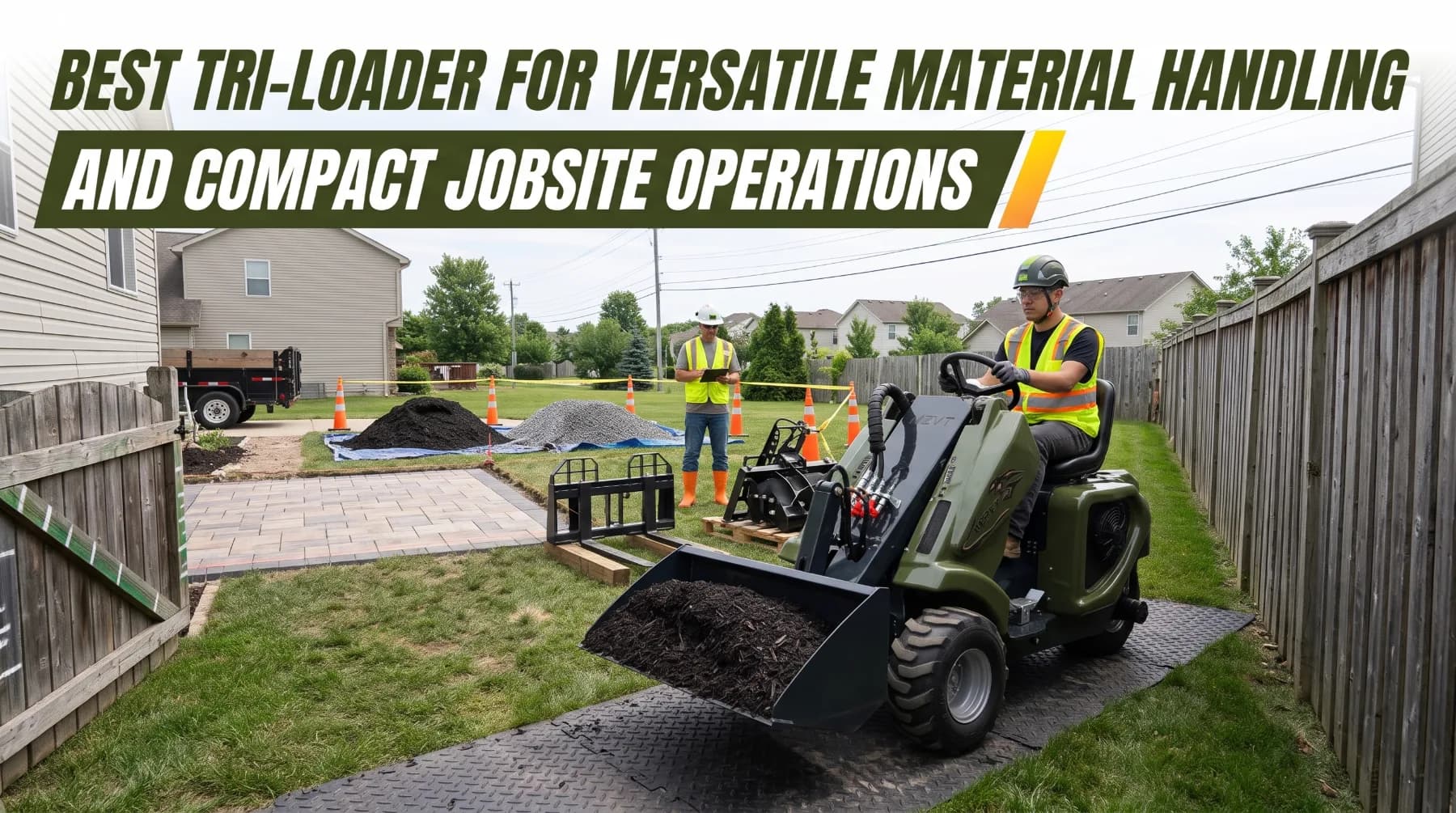
Many contractors work on jobs that are too large for hand tools but too tight for a full-size loader. A landscaping crew may need to spread twenty yards of mulch across a backyard behind a narrow gate. A property maintenance team may need to clear storm debris from a courtyard, then sweep a parking area the next morning. A fencing contractor may drill dozens of post holes along a property line where a larger machine would tear up the lawn. Each of these jobs needs real lifting, hauling, and attachment power in a compact package.
Tri-loaders fill that gap. A small footprint, compatible attachments, and practical lift performance let one machine handle landscaping, property maintenance, construction cleanup, and material transport in restricted work areas. On a well-matched job, a tri-loader replaces days of wheelbarrow trips and shovel work. It also gives a small crew the output of a much larger one.
"Best" depends on the work, not on the brochure. A machine that suits a residential landscaper who loads pickup trucks and drills fence holes may disappoint a contractor who moves pallets of blocks and runs a high-demand trencher all day. The right tri-loader fits your access routes, carries your real material weights, powers your attachments correctly, stays stable on your ground, and is supported by service and parts for years of use. A machine that's too large creates access and ground damage problems. One that's too limited leaves crews waiting, overloading, or renting extra equipment.
Comparing Lifting Capacity and Lift Height
Rated operating capacity describes the load a machine is designed to handle under specified conditions. It's the figure that matters for daily work, and it should be compared against the real weights your crews move, not against machine size or appearance. Two machines that look similar can carry noticeably different loads, and a compact machine that looks sturdy may have a modest rating.
The attachment counts toward that rating. A heavy bucket, grapple, or fork carriage uses part of the capacity before any material is added. Material density matters just as much. A full bucket of dry mulch may weigh little, while the same bucket of wet soil, gravel, sand, or broken concrete can approach or exceed the rated limit before it looks full. A single pallet of pavers, retaining wall block, or bagged material often outweighs what a compact loader can safely lift. Estimate loads by multiplying bucket volume by realistic material densities, and list the heaviest items your crews handle each week. If those regularly exceed a machine's rating, that machine isn't the right fit, however well it handles everything else.
Never confuse rated operating capacity with tipping load, and never treat hydraulic lifting force as a working limit. A machine may have the hydraulic strength to raise a load it can't keep stable. Where the manufacturer provides capacity figures for different attachments or load centers, use the figure that matches the real task.
Lift height determines where material can go. Contractors who load pickup beds, dump trailers, roll-off containers, or raised planters need enough height to clear the receiving edge. Hinge pin height and dump clearance are different measurements. Dump clearance, measured beneath the bucket's cutting edge at a stated dump angle, is the figure that shows whether material clears a sidewall. Dump reach shows how far into the bed the material lands. A machine with good clearance but short reach drops material at the near edge, leaving uneven loads and extra raking work.
Measure the sidewall heights of the vehicles you load most often, size for the tallest one you load routinely, and leave a margin for bucket rotation and heaped material. Then confirm the fit with a demonstration using your actual truck or trailer. Raising a load also raises the combined center of gravity, so a load that feels steady near the ground can affect stability far more at full height. Carry loads low, raise them only when stopped on firm, level ground, and lower the attachment fully before moving away.
Key takeaway: Compare rated operating capacity with real material and attachment weights, check dump clearance and reach against the vehicles you load, and never treat tipping load or hydraulic strength as a safe working limit.
Evaluating Hydraulic Performance
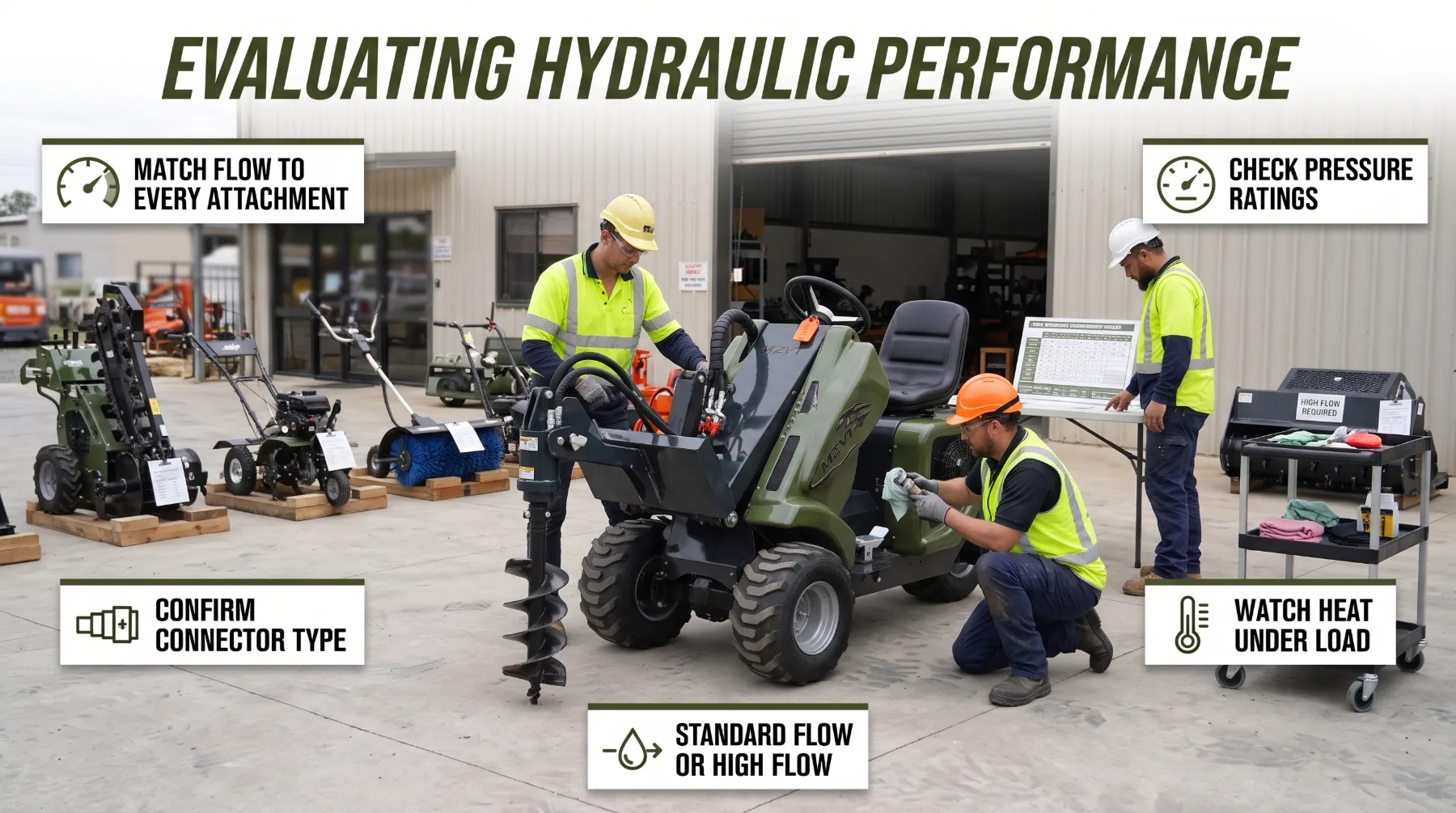
Hydraulic performance determines how well a tri-loader runs powered attachments and how responsive its lift and tilt functions feel. For contractors who rely on augers, trenchers, sweepers, tillers, brush cutters, or soil conditioners, auxiliary hydraulic specifications deserve as much attention as lift capacity.
Two figures matter most. Flow, usually stated in gallons per minute, influences how quickly hydraulic motors spin and cylinders move. Pressure, usually stated in pounds per square inch, contributes to the force or torque available. Each powered attachment has a required flow range and pressure rating set by its manufacturer. A trencher or tiller that receives too little flow runs slowly, stalls in heavy ground, and cuts poorly. One that receives too much can overspeed, overheat, and wear out early. Compare the machine's published auxiliary flow and pressure with the requirements of every attachment you plan to use, and choose a machine that meets your most demanding tool comfortably rather than barely.
Confirm whether the machine supports standard-flow or high-flow attachments. Many compact loaders deliver standard flow only, which suits most augers, grapples, and light-duty tools. High-demand attachments such as some trenchers, mulchers, and cold planers may need high flow that a compact machine can't supply. Check connector type and coupler size, whether the circuit offers continuous flow for rotating tools, and whether an attachment needs a case drain or dedicated return line. Never adjust relief settings or controls to force a mismatched attachment to run. That can damage the machine, the attachment, or both.
Sustained hydraulic demand produces heat. A machine running an auger or tiller for hours in warm weather depends on its hydraulic cooler, oil capacity, and clean cooling screens to hold temperature. Ask how the machine manages heat under continuous attachment use, and watch temperature indicators during a demonstration that mirrors your real workload.
Responsiveness completes the picture. Smooth, proportional lift and tilt control helps operators grade accurately, place material precisely, and dump without spillage. Test combined movements during a demonstration, such as lifting while curling the bucket or driving while running a sweeper. Watch whether functions blend smoothly or whether one slows sharply when another starts.
Key takeaway: Match the machine's auxiliary flow, pressure, and connection setup to your most demanding attachment, confirm standard-flow or high-flow capability, and test hydraulic response and heat management under realistic workloads.
Considering Stability and Ground Contact
A compact loader's narrow base and short wheelbase make it nimble, but they also make it more sensitive to load position, slopes, and ground conditions than a larger machine. Stability depends on operating weight, track or wheel configuration, load position, and the surface beneath the machine. All of these should be weighed against the ground your crews actually work on.
Tracked and wheeled configurations suit different conditions. Tracks spread weight over a larger contact area, which lowers ground pressure, improves traction on soft soil and loose fill, and limits rutting on prepared beds and lawns during straight travel. Wheels generally travel faster on firm, paved surfaces, scuff less when turning on hard ground, and cost less to maintain. A contractor who works mostly on residential lawns and freshly graded soil will often benefit from tracks. A property maintenance team that spends most of its time on parking lots and paved yards may prefer wheels. Tire type and tread pattern matter, too. Turf tires reduce lawn damage, while aggressive treads improve grip in mud but can mark finished paving.
Load position has a direct effect on stability. The farther forward and higher a load sits, the more leverage it creates against the machine's counterweight. Carry loads low, with the attachment just high enough to clear the ground, and keep them centered in the bucket or pushed fully back on the forks. Long pallet forks and wide attachments move the load farther forward and reduce what the machine can carry safely.
Slopes need strict discipline. Follow the manufacturer's slope limits for loaded and unloaded travel, travel straight up and down rather than across, and keep the heavy end uphill in the direction the manual specifies. Avoid turning on inclines, and never raise a load on a side slope. Keep the machine well back from trench edges, excavations, and retaining walls, since the ground may give way beneath a loaded machine. Before digging with augers or trenchers, contact the local utility locating service, 811 in the United States, and wait for lines to be marked. Ask property owners about private lines such as irrigation, lighting, and septic systems.
Evaluate the surfaces where the machine will work most often, including lawns, gravel, compacted soil, mulch beds, and construction areas. Then ask for a demonstration on similar ground with a representative load.
Key takeaway: Choose tracks or wheels based on your most common ground conditions, carry loads low and centered, stay within the manufacturer's slope limits, and keep the machine back from edges and excavations.
Looking at Operator Controls and Visibility
Controls and visibility shape how accurately and safely operators work through a full day. A machine that's comfortable, intuitive, and easy to see from will produce cleaner grading, more precise loading, and fewer near misses than one that leaves the operator straining to see the attachment or guessing at the controls.
Start with the operator position. Some compact loaders use a seated station with a protective structure, seat belt, and restraint bar. Others use a stand-on platform at the rear that gives a clear view of the attachment and allows quick mounting and dismounting. Each layout has trade-offs. Seated machines offer more protection and comfort over long shifts, while stand-on designs suit work that involves frequent stops to move materials or check grade. Whichever layout you choose, confirm that protective structures, seat belts, operator presence systems, and parking brakes meet the manufacturer's design. Never bypass, tie down, or disable these systems.
Evaluate the control layout with the people who will run the machine. Check whether the controls are logical, whether lift, tilt, and drive functions respond proportionally, and whether auxiliary hydraulic controls are easy to operate while steering. Ask how long it takes a new operator to become confident. Controls differ widely between manufacturers, so an operator familiar with one machine may find another responds very differently. Every operator should receive hands-on training on the specific model before carrying loads.
Visibility deserves close attention during a demonstration. Look at sightlines to the bucket edge, the fork tips, the sides of the machine, and the area behind it. Check whether lift arms, the protective structure, or engine covers create blind spots. Mirrors, cameras, and work lights help where fitted, and they should be kept clean and adjusted. Be especially careful when reversing. Stand-on operators can be trapped between the platform and a wall, fence, or post, so look behind before every reverse movement and keep backing distances short and controlled.
Visibility aids don't replace good site control. Use a trained spotter at blind corners and loading points, keep people out of the machine's travel path and away from raised attachments, and agree on hand signals before work begins. Look up as well. A raised attachment can reach overhead power lines, so maintain the required clearance distances and treat every line as energized.
Key takeaway: Choose an operator position and control layout that suits your work, confirm clear sightlines to the attachment and surroundings, train operators on the specific model, and never bypass operator protection or presence systems.
Considering Maintenance and Attachment Support
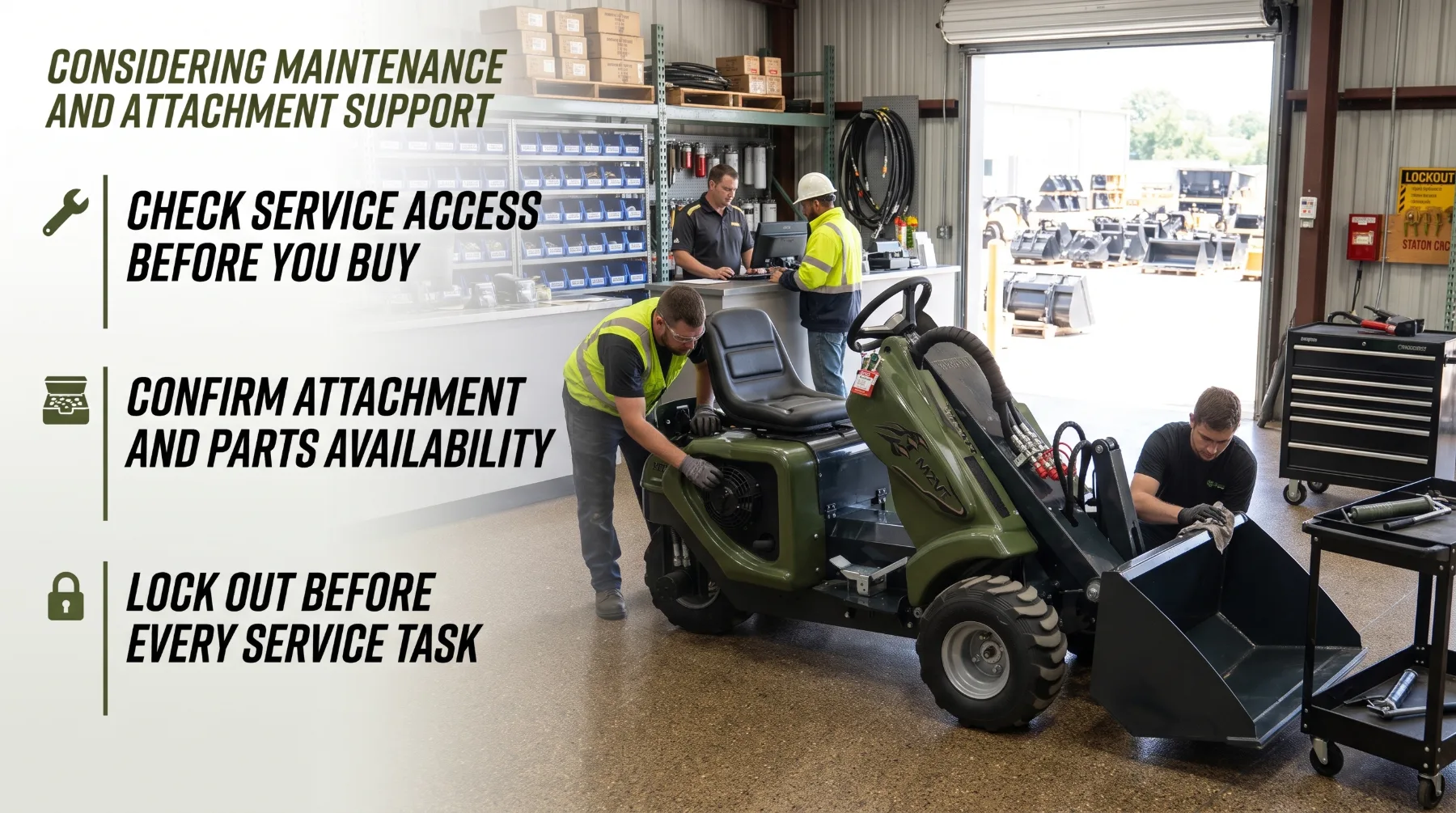
The purchase price is only part of what a tri-loader costs. Over its working life, maintenance, parts, attachments, and downtime often decide whether a machine pays for itself. A model that's easy to service and well supported by a local dealer will usually deliver better long-term value than one that's slightly cheaper but difficult to maintain.
Check service access before you buy. Open the engine and hydraulic compartments and look at how easily technicians can reach filters, dipsticks, fill points, grease fittings, cooling screens, belts, and battery connections. Daily checks should take minutes, not require removing panels. Ask about service intervals for engine oil, hydraulic oil, filters, and the undercarriage, and compare the routine costs between models. On tracked machines, consider track and roller replacement costs. Packed mud and debris speed up undercarriage wear, so easy cleaning access saves money over time. On battery-electric models, review charging requirements, battery warranty, and expected runtime under your typical workload.
Daily inspection protects both the machine and the crew. Before each shift, check lift arms, pivot pins, the attachment plate, hydraulic hoses and couplers, tracks or tires, fluid levels, and safety systems. Never use your hand to search for a hydraulic leak. Fluid escaping under pressure can penetrate skin and cause an injection injury that requires immediate emergency medical treatment, even when the wound looks minor. Use a piece of cardboard instead, and wear gloves and eye protection. Before any service, lower the attachment to the ground, shut down the engine, remove the key, apply your site's lockout procedure, and relieve hydraulic pressure according to the manufacturer's instructions. If the lift arms must stay raised, use the manufacturer's approved lift arm support device.
Attachment support deserves equal weight. Confirm that the machine's mounting system accepts the attachments you need, and that those attachments are available, approved for the machine, and suited to its weight class and hydraulic output. Many compact loaders use a mounting plate that differs from the universal quick-attach system on full-size skid steers, so attachments built for larger machines may not fit and are often too heavy. After every attachment change, verify that the locking pins or levers are fully engaged before lifting.
Finally, evaluate the dealer. Check parts availability, warranty coverage, service response times, technician training, and whether loaner or rental machines are available during repairs. Ask how quickly common items such as filters, hoses, teeth, and wear parts can be supplied. Strong dealer support shortens downtime and protects resale value when it's time to upgrade.
Key takeaway: Compare service access, routine maintenance costs, attachment compatibility, parts availability, and dealer support alongside purchase price, and build daily inspections and safe lockout into every operator's routine.
Conclusion
The best tri-loader for your business is the one that matches your daily material handling demands and jobsite conditions. Machine dimensions must suit your access routes with clearance to spare. Rated operating capacity, lift height, dump clearance, and reach must match the real weights you move and the vehicles you load. Auxiliary hydraulic flow and pressure must power your attachments correctly without overheating. A track or wheel configuration suited to your ground keeps the machine stable and protects finished surfaces. Comfortable controls and clear visibility help operators work accurately and safely, while practical service access and dependable dealer support keep the machine productive for years.
Frequently Asked Questions
What jobs can a tri-loader perform?
A tri-loader can support material handling, landscaping, property maintenance, construction cleanup, and material transport in restricted areas. With compatible attachments, it can grade soil, spread mulch and base material, carry pallets, load trucks and trailers, drill post holes, dig trenches, clear brush and debris, and sweep surfaces. The range of work depends on the machine's rated capacity, hydraulic output, dimensions, and the attachments approved for that model.
What is the most important tri-loader specification?
No single specification suits every business. Rated operating capacity, overall dimensions, lift height and dump clearance, auxiliary hydraulic flow and pressure, and attachment compatibility should be evaluated together. A machine with strong lift performance but too much width for your gates, or ample capacity but too little hydraulic flow for your trencher, won't serve you well. Base the decision on the jobs you perform most often.
Can one tri-loader use multiple attachments?
Yes, when each attachment is compatible with the machine's mounting system, weight class, and hydraulic output. Confirm that the attachment's flow and pressure requirements fall within the machine's auxiliary specifications, check connector types and any return-line needs, and count attachment weight against rated capacity. After every change, verify that the locking pins or levers are fully engaged before lifting or operating the attachment.
Should contractors choose the smallest available tri-loader?
Not automatically. A smaller machine fits through tighter openings and causes less ground disturbance, but it may lack the capacity, lift height, or hydraulic flow your work requires. Choose the machine that fits your typical access routes with safe clearance while still handling your real material weights and attachments. For occasional jobs with unusually tight access, renting a smaller unit is often more economical than undersizing your main machine.