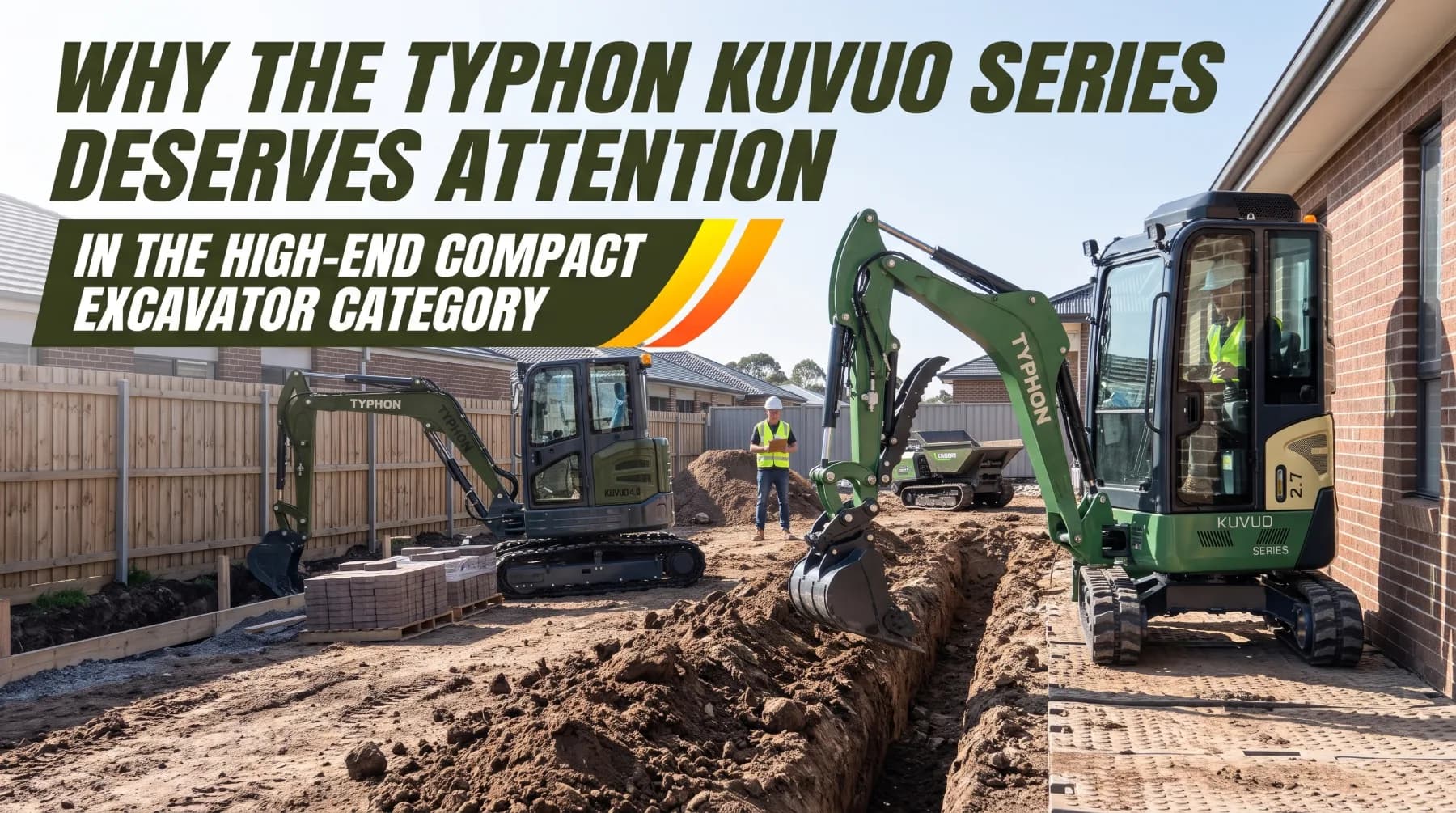
A landscaping contractor has a backyard drainage project behind a row of townhomes. The only access is a side passage barely wider than a garden gate. The trench must run deep enough to carry stormwater away from a foundation, and the homeowner expects the lawn and patio to look untouched when the crew leaves. A small, basic machine might fit through the gate but struggle at depth. A larger excavator could dig the trench easily but would never reach the backyard. Jobs like this reveal what separates a high-end compact excavator from an ordinary one.
High-end compact excavators are judged on how well they combine hydraulic engineering, digging capability, operator controls, comfort, and overall machine design. A headline specification can attract attention, but daily productivity depends on how every system works together on real jobsites. The TYPHON KUVUO Series is positioned for contractors, landscapers, and fleet buyers who want compact excavation equipment built for demanding professional work.
Within the series, the KUVUO 2.7 offers a well-documented example of that approach. Its published specifications include a maximum digging depth of 6.07 feet, a maximum digging distance of 9.94 feet, a variable-displacement axial piston pump, full pilot controls, a Kubota D1105 diesel engine, a retractable undercarriage, and an enclosed cab with heating and air conditioning. The KUVUO 4.0 extends the series into a larger size class for buyers who need more machines for heavier digging and bigger daily volumes. Features and specifications vary by model and configuration, so every buyer should evaluate each machine on its own documented capabilities.
Compact Design for Professional Applications
Compact excavators earn their place on jobsites where larger machines can't reach, can't fit, or would cause too much disturbance. Trenching, landscaping, utility installation, drainage work, and foundation excavation regularly take place in backyards, between buildings, along fence lines, and on finished properties. For professional users, compact design isn't a convenience. It often decides whether a job can be done with a machine at all.
Operating weight affects nearly every part of ownership. It determines the trailer and tow vehicle needed for transport, the pressure the machine places on lawns and paving, and how stable the machine feels while digging and lifting. A heavier machine generally provides a more solid working platform, while a lighter one is easier to transport and gentler on finished surfaces. Check how the manufacturer defines the published operating weight, since some figures include fuel, an operator, and a standard bucket while others do not. When planning transport, add the weight of attachments and accessories carried with the machine.
Width is often the deciding factor on residential and infill sites. Side gates, fence openings, and passages between houses set firm limits on which machines can reach the work area. The KUVUO 2.7 addresses this with a retractable undercarriage that narrows to approximately 39 inches for travel through suitable access points and expands to approximately 51.2 inches for a steadier working stance. The KUVUO 4.0 serves a different purpose. As the larger model, it trades some tight-access flexibility for the capability of a bigger platform. Compare its published overall width and track configuration against your typical sites rather than assuming it will fit everywhere the 2.7 does.
Tail swing describes how far the rear of the upper structure extends beyond the tracks as the machine rotates. Zero-tail-swing and reduced-tail-swing designs keep the counterweight closer to the track footprint, which helps operators work beside walls, fences, and traffic with less risk of striking obstacles. Confirm the tail swing design for the exact KUVUO model you're considering, then measure the working space at your most common job types. A compact excavator must also reach the site before it can dig, so review transport length, width, and height alongside operating weight. Confirm that your trailer's payload, gross weight, and axle ratings cover the machine and its attachments, and that your tow vehicle stays within its towing limits.
Key takeaway: Compare operating weight, overall width, tail swing, and transport dimensions for each KUVUO model against your access routes and transport setup, because compact design only adds value when the machine can reach and work safely within the available space.
Evaluating the Complete Machine
A premium product description can draw attention, but the right purchase depends on documented capability. The most reliable way to judge any KUVUO model is to evaluate it as a complete system against the work your business performs every day. Review these five areas before you decide.
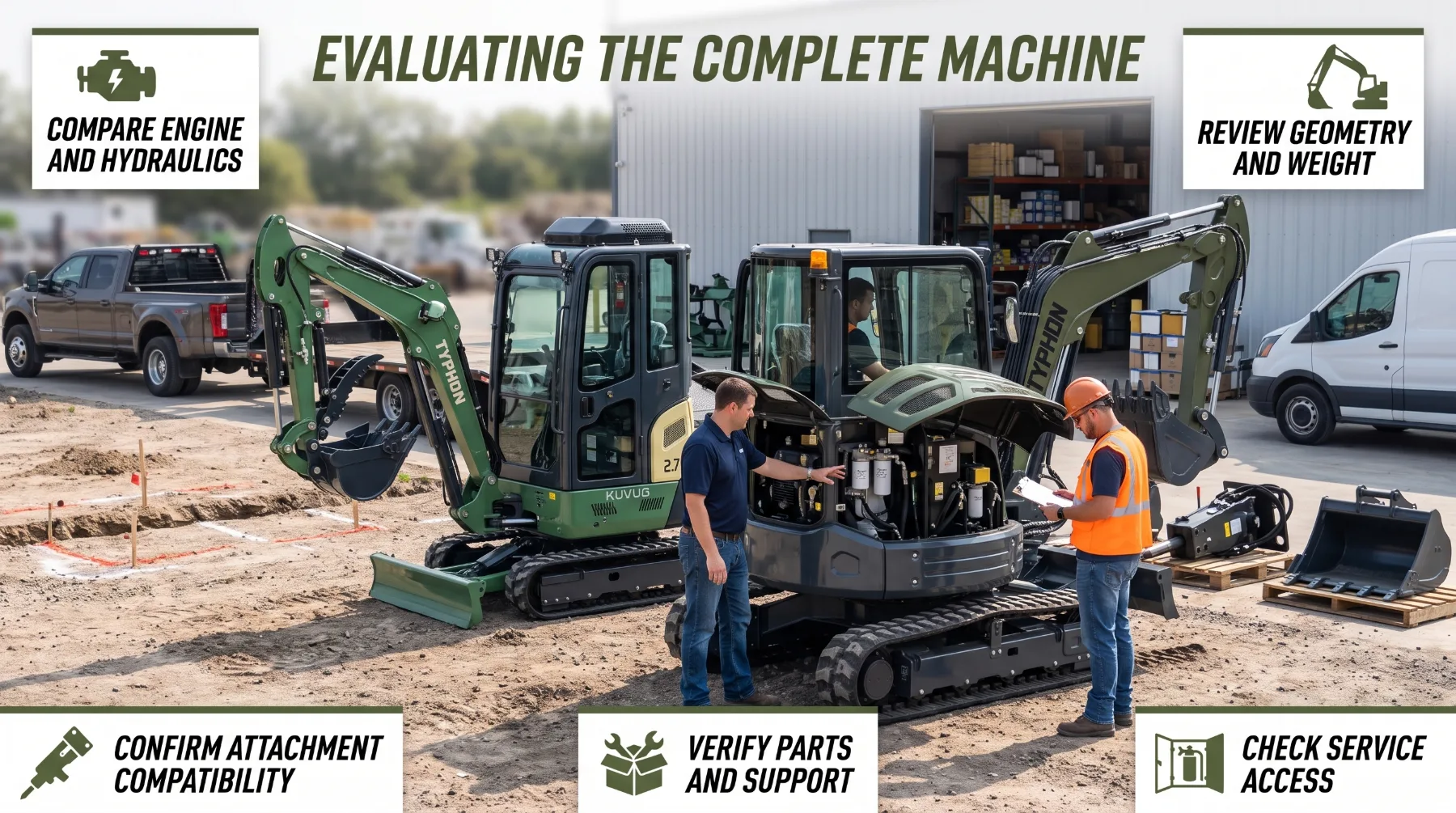
Engine and Hydraulics: Compare engine output alongside pump type, flow, and pressure, since performance comes from how these systems work together.
Digging Geometry and Weight: Review the working-range diagram, operating weight, and track configuration against your typical excavation and access requirements.
Attachment Compatibility: Confirm coupler type, auxiliary flow and pressure, connection requirements, and approved attachments for every tool you plan to run.
Service Access and Maintenance: Check how easily daily inspections, filter changes, and greasing can be completed, and review recommended service intervals.
Parts and Support: Confirm parts availability, warranty terms, technician access, and local service coverage for the exact model.
Augers, breakers, grading buckets, trenching buckets, and thumbs can extend what a compact excavator does. Each attachment has specific weight, mounting, and hydraulic requirements. Too little auxiliary flow makes tools slow or prone to stalling, while excessive flow or pressure can overheat components. Match every tool to the exact model's ratings, and remember that heavier attachments affect balance and lifting limits. High-end equipment should stay productive for years, so easy service access encourages consistent daily inspections and dependable parts supply keeps downtime short. Include fuel, fluids, filters, wear parts, and potential downtime in your total cost comparison, as a machine with strong local support often delivers better long-term value than one chosen on purchase price alone.
The KUVUO 2.7 and KUVUO 4.0 serve different workloads. The 2.7 suits restricted residential, landscaping, and utility sites where access and precision matter most. The 4.0 suits heavier digging, larger buckets, and bigger daily volumes. Many fleets find the two complement each other. Select according to documented capability and your actual workload, not simply the premium positioning of the series.
Key takeaway: Evaluate each KUVUO model as a complete machine by comparing engine output, hydraulic ratings, digging geometry, operating weight, attachments, service access, and parts support against your real workload, rather than relying on any single specification or product description.
Digging Range and Working Capability
Digging range determines what work a compact excavator can complete from a single setup position. Each time an operator stops to reposition, the cycle pauses, the tracks disturb more ground, and the job loses time. A machine whose working envelope matches your typical tasks completes more work with fewer moves.
Maximum digging depth indicates how far below ground level the bucket can reach under specified conditions. The KUVUO 2.7 lists a maximum digging depth of 6.07 feet, which gives contractors a clear benchmark for utility trenches, footing excavation, drainage installation, and landscape work. Required depth depends on the job. Water lines in cold climates may need to sit below the frost line, drainage systems need consistent fall, and footings must reach design depth and bearing soil. Compare the published figure with the depths your projects require most often, leaving a sensible margin rather than planning to dig at the machine's absolute limit every day. Maximum digging distance, sometimes called reach, describes how far the bucket can extend horizontally from the machine. The KUVUO 2.7 lists a maximum digging distance of 9.94 feet, and greater reach lets operators work across a trench, place spoil farther from the edge, or dig without moving onto soft or finished ground.
Digging height shows how high the bucket can reach during excavation movements. Dump height describes the clearance available to discharge material into a truck, dumper, or container. If your crew loads trucks regularly, confirm that the dump height clears the sides of the vehicles you use. Bucket capacity affects how much material moves with each pass. A larger bucket can improve productivity in open excavation, while a narrow bucket suits trenching and precise work. Bucket choice also affects breakout force and the machine's balance, so use only buckets approved for the specific model and match bucket width to the trench or task.
Key takeaway: The KUVUO 2.7's 6.07-foot digging depth and 9.94-foot reach define a clear working envelope, so compare depth, reach, dump height, and bucket capacity for each KUVUO model with your actual trench, footing, and loading requirements using the full working-range diagram.
Piston Pump Hydraulic Engineering
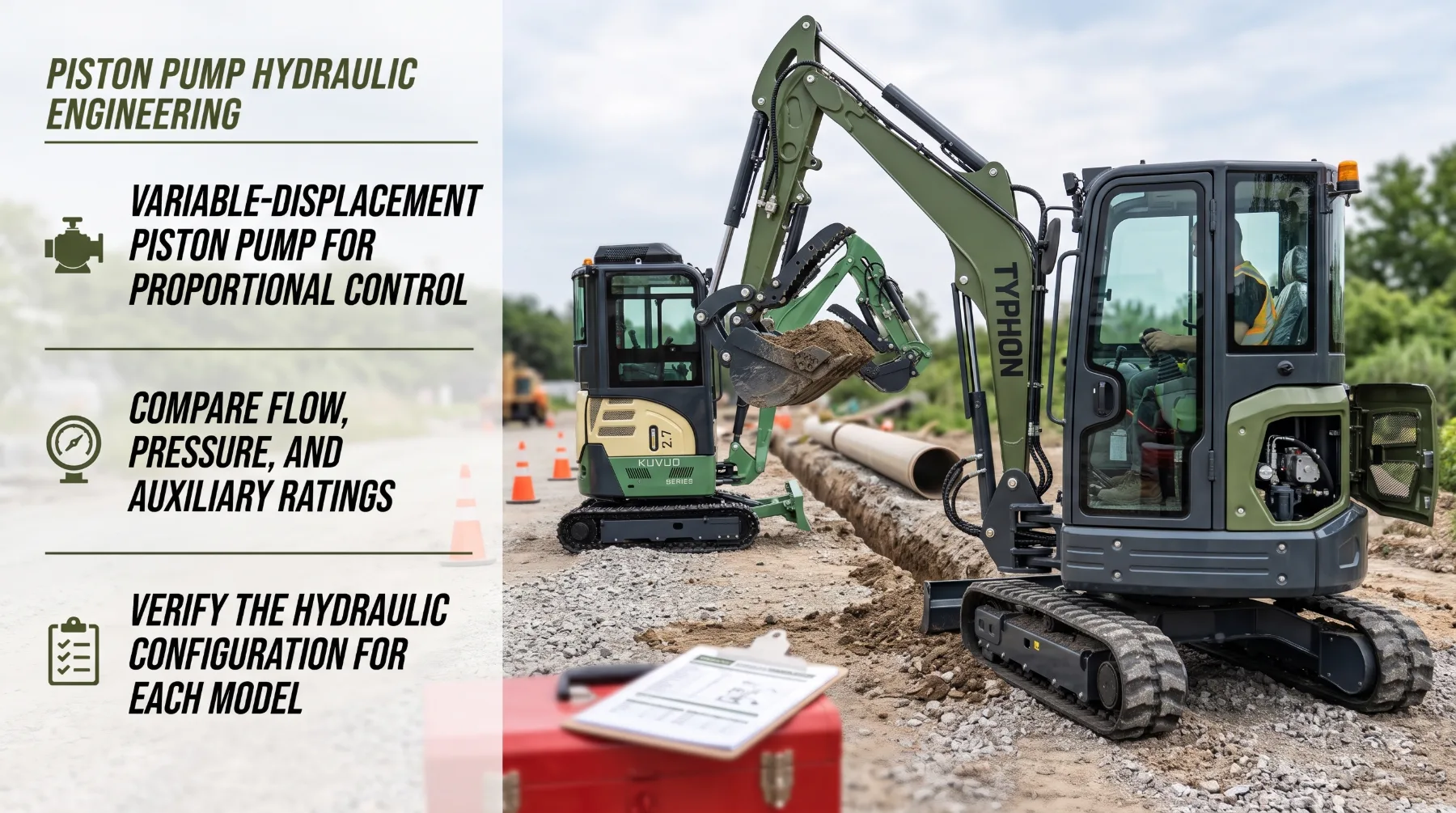
Every boom raise, arm curl, bucket pass, and swing depends on the hydraulic system. Hydraulic engineering is one of the clearest differences between entry-level compact excavators and machines designed for demanding professional use, which makes it a central part of the KUVUO Series' appeal.
Hydraulic pumps convert engine power into fluid flow that drives cylinders and motors. Gear pumps are common on simpler machines because they are economical and straightforward. Piston pumps are more complex and are widely used where efficiency and controlled response matter. A variable-displacement axial piston pump can adjust how much fluid it delivers per revolution as demand changes. During heavy breakout, the system can supply the flow the work requires. During lighter positioning moves, it can deliver less. That adaptability supports smoother, more proportional control and helps reduce wasted energy.
The KUVUO 2.7 uses a variable-displacement axial piston pump with a listed displacement of 28 ml/rev. Its published total hydraulic flow is 17.91 GPM, and its system pressure is approximately 2,973 PSI. Paired with full pilot controls, this configuration is built to deliver responsive, measured movement during detailed work such as trimming along a footing, cleaning a trench bottom, or setting a bucket beside a wall. Piston pump technology is an important consideration on applicable KUVUO configurations, but buyers should never assume every model or configuration shares the same hydraulic system. When evaluating the KUVUO 4.0 or any other variant, confirm pump type and displacement, total hydraulic flow, system pressure, auxiliary circuit flow and pressure, and auxiliary connection types including any return or case drain requirements.
A piston pump alone doesn't guarantee superior performance. Hydraulic results depend on pump design, displacement, engine output, valve design, system pressure, and flow working together. Fluid condition matters too, since contaminated or overheated oil reduces responsiveness on any excavator. Review the complete hydraulic specification and confirm that the machine suits the tasks and attachments you plan to run.
Key takeaway: The KUVUO 2.7's 28 ml/rev variable-displacement piston pump, 17.91 GPM flow, and approximately 2,973 PSI system pressure support responsive, proportional control, but buyers should verify pump type, flow, and pressure for each KUVUO model and judge the hydraulic system as a whole.
Controls and Operator Experience
Operators feel a machine's engineering through the controls. Smooth, predictable response lets them work precisely beside foundations, fences, and marked utilities. Jerky or delayed response slows the work, increases fatigue, and makes accurate digging harder. For high-end compact excavators, control quality is a core performance feature.
The KUVUO 2.7 uses full pilot controls. In a pilot-operated system, joystick movement sends low-pressure hydraulic signals to the main control valves. That allows proportional response, where small joystick inputs produce small, measured movements and larger inputs produce faster ones. Operators can feather each function rather than jerking the boom or bucket into position. Pilot controls also reduce physical effort compared with direct mechanical linkages, which helps operators maintain accuracy from the first pass to the last over a full shift of repetitive trenching or grading.
Good digging requires operators to coordinate the boom, arm, bucket, and swing simultaneously, and control layout affects how naturally that coordination comes. Consider joystick position, feel, and reach for different operators, pedal arrangement for travel and auxiliary functions, switch placement for auxiliary hydraulics and climate control, and whether the control pattern matches what your operators already know. Many excavators allow operators to change the control pattern, so confirm which patterns each KUVUO model supports. Controls only feel precise if the hydraulic system responds consistently. The way the pump, valves, and engine work together determines how the machine behaves when several functions run at once, such as swinging while raising the boom with a loaded bucket. A well-matched system maintains smooth movement under combined loads rather than slowing one function to feed another.
Specification sheets describe controls, but a demonstration reveals them. During a test, check response to small corrections near a wall or marked utility, smoothness during combined movements under load, effort required over repeated cycles, and how quickly a new operator becomes confident with the machine. Bring the operators who will run the machine every day, as their impressions of control often matter more than any figure on paper.
Key takeaway: The KUVUO 2.7's full pilot controls support proportional, low-effort operation, but buyers should confirm the exact control configuration for each KUVUO model and test layout, response, and coordination during a hands-on demonstration.
Cab, Visibility, and Undercarriage
Operator comfort, sightlines, and undercarriage design all influence how productive a compact excavator is across a working day. These features are where buyers most often make assumptions, and where careful verification pays off, because configurations may differ across the KUVUO Series.
The KUVUO 2.7 offers an enclosed cab with heating and air conditioning. An enclosed cab reduces direct exposure to rain, wind, cold, heat, and some dust, and climate control helps operators stay alert through summer heat and cold mornings, which supports both accuracy and safety. Not every enclosed cab provides the same level of protection, since sealing, ventilation, and filtration vary by design. When evaluating any KUVUO model, confirm whether heating, air conditioning, ventilation, and filtration are included in the exact configuration rather than assuming every machine in the series is equipped identically.
Good visibility helps operators monitor the bucket, tracks, trench edges, nearby structures, and people on the ground. Cab pillars, window size, boom position, and lighting all affect sightlines. To keep visibility clear, clean glass at the start of each shift, use defrost and ventilation to prevent fogging, check mirrors, lights, and cameras where fitted, and use a trained spotter in confined or congested areas.
The KUVUO 2.7's retractable undercarriage adjusts from approximately 39 inches for travel through suitable access points to approximately 51.2 inches for work. That flexibility lets operators enter tight sites with a slim profile, then widen the footprint for steadier digging, swinging, and lifting. Retractable tracks are only beneficial when used correctly, so follow the manufacturer's approved procedure, expand the tracks to working width wherever the site allows, and assess ground conditions before digging or lifting. Soft fill, saturated soil, and unsupported trench edges reduce stability regardless of track width. Depending on the model, KUVUO configurations may include an enclosed cab, heating, air conditioning, or retractable tracks, so confirm the exact equipment included on the machine you're considering and inspect the operator area and undercarriage in person when possible.
Key takeaway: The KUVUO 2.7's enclosed cab with heating and air conditioning and its retractable 39- to 51.2-inch undercarriage support comfort and access, but configurations vary across the KUVUO Series, so verify cab features, sightlines, and undercarriage design for each model.
Conclusion
The TYPHON KUVUO Series is worth considering in the high-end compact excavator category, combining compact dimensions, piston pump hydraulic technology, practical digging performance, and operator-focused features. Its design supports contractors working in restricted spaces while providing the hydraulic capability, working range, and control needed for demanding excavation tasks. Features such as pilot controls, retractable undercarriages, and enclosed climate-controlled cabs add versatility and operator comfort. Individual models offer different levels of digging depth, reach, and capacity, so buyers should compare specifications carefully rather than assume every feature is shared across the series. A good purchasing decision starts with measuring jobsite access, identifying typical digging requirements, and checking transport limitations. Contractors should also confirm hydraulic compatibility with their attachments and review local parts availability and service support. Requesting model-specific specification sheets and working-range diagrams, followed by a practical demonstration, helps verify that the selected excavator meets actual job requirements. Choosing the right KUVUO model allows contractors to balance performance, accessibility, comfort, and long-term operating value.
Frequently Asked Questions
What makes a compact excavator high-end?
Hydraulic engineering, build quality, control response, operator comfort, working capability, and service support all contribute. No single specification defines a high-end machine. The best compact excavators balance these systems so they perform consistently under real working conditions over many years.
Does every KUVUO model have the same hydraulic system?
Don't assume so. The KUVUO 2.7 uses a variable-displacement axial piston pump with 28 ml/rev displacement, 17.91 GPM flow, and approximately 2,973 PSI system pressure. Verify the pump type, flow, pressure, and auxiliary circuit ratings for each individual model and configuration.
Why are digging depth and reach important?
They determine whether the excavator can complete the required work without frequent repositioning or a larger machine. Depth must meet trench and footing requirements, while reach affects spoil placement and working distance from edges. Review the full working-range diagram, since maximum figures describe only the outer edge of the envelope.
What should buyers compare before purchasing a KUVUO excavator?
Review engine output, hydraulic system, digging range, operating weight, dimensions, tail swing, controls, cab features, undercarriage design, attachment compatibility, and service support. Compare those specifications with your typical jobs, and confirm your choice with a hands-on demonstration.