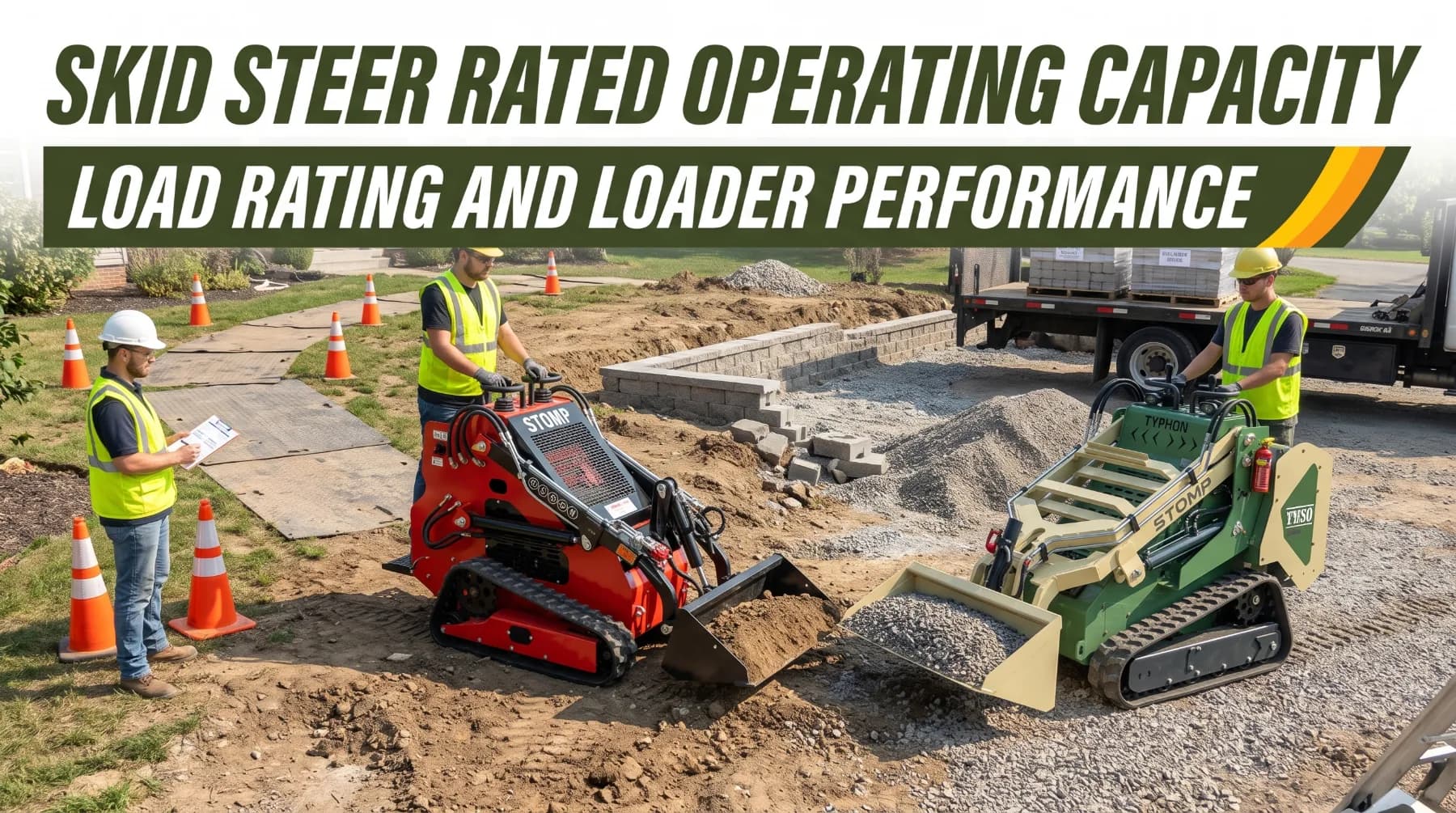
The trouble starts when he raises the pallet toward the top of the wall. Partway up the lift, the forks reach their farthest point forward. The rear of the machine goes light, and the tracks begin to lift off the ground. The operator reacts quickly and lowers the arms. The pallet's weight shifts, and several blocks slide off the front of the forks onto the lawn.
Rated operating capacity is the most important load rating on any skid steer or compact track loader. Knowing how it's determined, how it differs from tipping load, and how attachments, load position, and lift height change it is the foundation of safe and productive material handling. It also guides better buying decisions. This guide explains each factor in practical terms, so you can select a loader that handles your daily work within its rated limits and help your operators run it with confidence.
Understand Rated Operating Capacity
Rated operating capacity, or ROC, is the manufacturer's stated load limit for a skid steer or compact track loader during normal operation. It tells operators how much weight the machine is rated to lift and carry with a specified attachment under defined conditions. Every other decision about loading, lifting, and traveling should start from this number. It appears in the operator's manual, on the specification sheet, and often on a decal inside the cab.
The published ROC applies to a specific configuration. Manufacturers typically state it with a standard bucket of a given size, standard tires or tracks, and the machine's stated operating weight. Many also publish separate ratings for pallet forks or optional counterweights. When the configuration changes, the rating changes. A heavier attachment, a longer load center, different tires, or removing a factory counterweight can each reduce the capacity available for material. Always confirm which configuration your ROC figure applies to.
Treat ROC as the ceiling for everyday work, not a target to approach on every lift. It already includes a safety margin below the point where the machine becomes unstable. That margin exists to absorb real conditions that test pads don't capture: uneven ground, bumps, sudden stops, soft soil, and the dynamic forces of a moving load. Operators who stay within ROC protect that margin. Operators who exceed it use up the protection meant for the moments when something unexpected happens.
Key takeaway: Rated operating capacity is the manufacturer's load limit for a defined machine and attachment configuration, determined under standards such as ISO 14397-1. Confirm the configuration behind every ROC figure, and treat it as the ceiling for daily work.
Distinguish ROC From Tipping Load

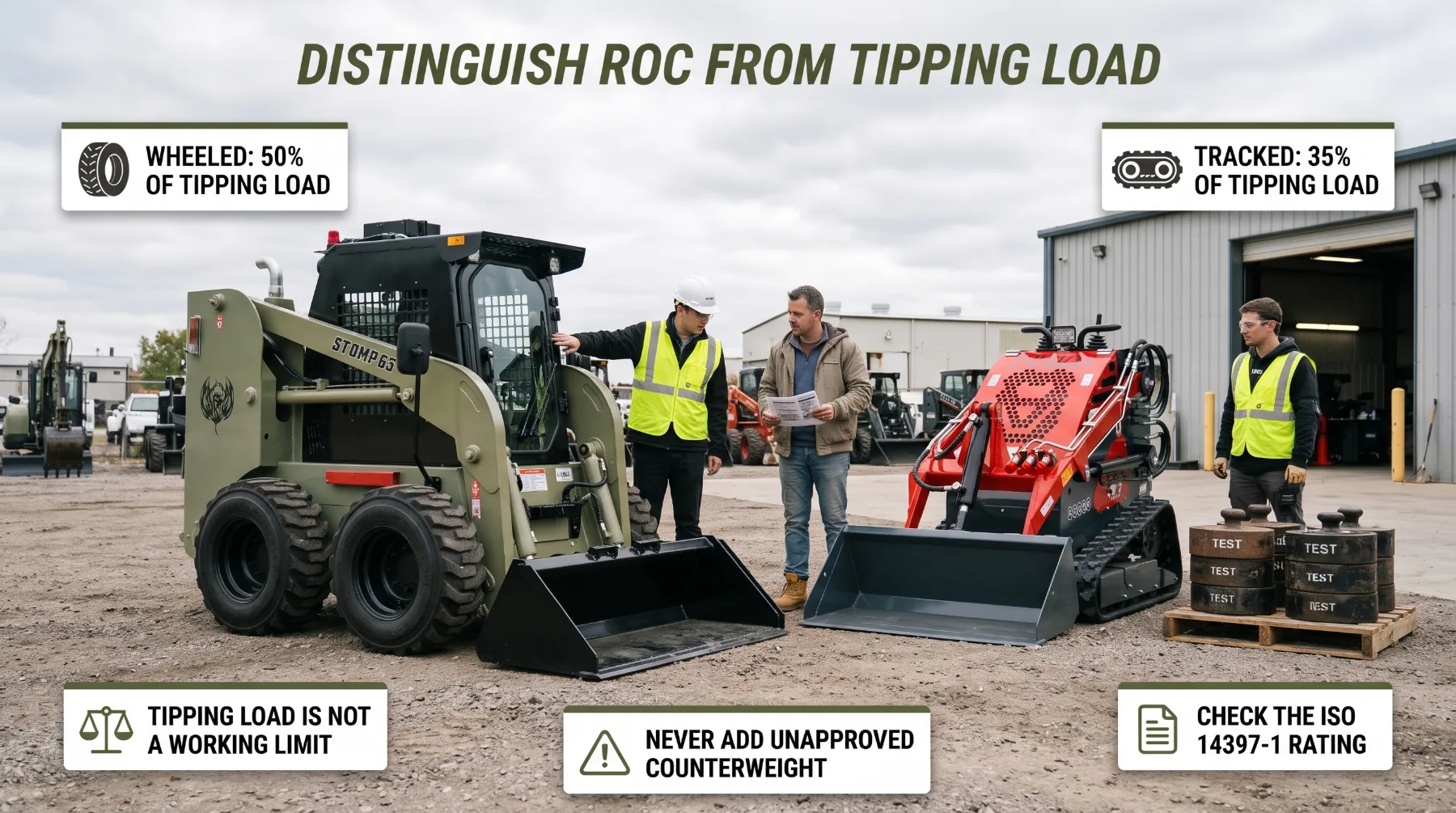
Tipping load and rated operating capacity often appear side by side on a specification sheet, and confusing them is one of the most common and dangerous mistakes in skid steer operation. Tipping load is a test measurement. ROC is the working limit. The opening scenario shows exactly what happens when an operator treats one as the other.
Tipping load is the minimum weight, at a specified load center, that causes the rear of the machine to lift off the ground under controlled test conditions. During testing, the machine sits on a firm, level surface at its stated operating weight, and load is applied until the machine reaches its balance point. At that moment, the front axle or front of the tracks becomes a pivot, and the loader is no longer stable. In real use, a machine at tipping load has no steering control, no traction at the rear, and no margin left for movement. Tipping load describes the point of failure. It is never a working figure.
When you read a spec sheet, identify which figure is which before comparing models. Tipping load is useful for understanding the machine's stability and for calculating ROC. It tells you nothing about what you should lift on a jobsite. Train every operator to know the ROC of the machine and attachment they're running, and remove any doubt by posting it clearly in the cab or on the attachment where manufacturer decals allow.
Never try to raise capacity by improvising. Adding an unapproved counterweight, attaching loads to the rear of the machine, or having a person stand or sit on the back to balance a load are all dangerous practices. They change the machine's stability characteristics in ways the manufacturer never tested, and they can overload axles, tracks, and lift components. If your work regularly calls for more capacity, use a manufacturer-approved counterweight package where available, or choose a larger machine.
Key takeaway: Tipping load is the point where the machine becomes unstable, while ROC is the safe working limit. ROC is 50 percent of tipping load for wheeled skid steers and 35 percent for compact track loaders under ISO 14397-1, and tipping load is never a working figure.
Account for Attachment Weight
Every attachment changes the load the machine carries. A bucket, pallet forks, grapple, auger, broom, or trencher adds its own weight to the front of the loader, and many attachments also hold their load farther from the machine than a standard bucket does. Both effects reduce the capacity available for material, sometimes by a significant amount.
Keep attachment connections in good condition as part of every capacity decision. Confirm that the quick coupler locks fully on both sides, that locking pins or levers are engaged, and that the attachment is free of cracks, bent mounting plates, and worn pins. A heavy load on a poorly secured attachment creates a serious risk of the attachment releasing or shifting during lifting.
Key takeaway: Attachment weight and load center both reduce the capacity available for material. Confirm the net ROC for each approved attachment and loader combination, load by weight rather than volume, and never use light-material buckets for dense materials.
Compare Machine Design and Hydraulic Performance
Lift arm geometry shapes how capacity behaves through the lift. Radial lift machines generally provide strong digging and pushing force at lower arm heights and good reach at mid-height. They suit grading, excavation, and work below eye level. Vertical lift machines keep the load closer to the machine as it rises, which typically provides better reach and more consistent capacity at full height. That makes them well suited to loading high-sided trucks, stacking pallets, and placing material over walls. Neither design is universally better. When comparing machines, review lift height, hinge pin height, dump height, and dump reach together with ROC for the applications your crews perform most.
Machine weight and balance set the foundation for stability. A heavier machine with weight concentrated at the rear resists tipping better, which is why manufacturers place engines and counterweights at the back of the frame. Some offer optional counterweight packages that raise ROC when installed according to the manufacturer's instructions. Wheelbase and track length also matter. A longer wheelbase or track frame generally provides a more stable base and a smoother ride when carrying loads. Operating weight affects ground pressure, transport requirements, and suitability for finished surfaces, so balance capacity against site conditions.
Tire and track configuration changes how the machine handles load. Wheeled skid steers perform well on firm, dry surfaces and pavement, offer faster travel, and generally cost less to maintain. Tire type and pressure affect stability, so check pressure regularly and follow the manufacturer's specification. Compact track loaders spread weight over a larger area, which improves traction and flotation on soft, wet, or uneven ground. That advantage explains why many contractors prefer tracked machines for landscaping and site preparation, even though ROC is calculated at a lower percentage of tipping load. Keep tracks correctly tensioned, since loose tracks reduce stability and can derail under load.
Key takeaway: Lift arm geometry, hydraulic pressure, cylinders, machine weight, wheelbase, and tires or tracks all shape loader performance. Review lift height, breakout force, and hydraulic flow alongside ROC, and remember that neither breakout force nor flow increases rated capacity.
Consider Load Position and Height
Leverage is the key principle. The loader balances on its front axle or the front of its tracks, with the machine's weight behind that pivot point resisting the load in front of it. A load held close to the machine creates less leverage than the same load held farther forward. When a load moves outward, whether because the lift arms extend forward, the attachment tilts forward, or the load slides forward on the forks, its effect on stability increases. Keep loads as close to the machine as the work allows, and position pallets fully back against the fork carriage.

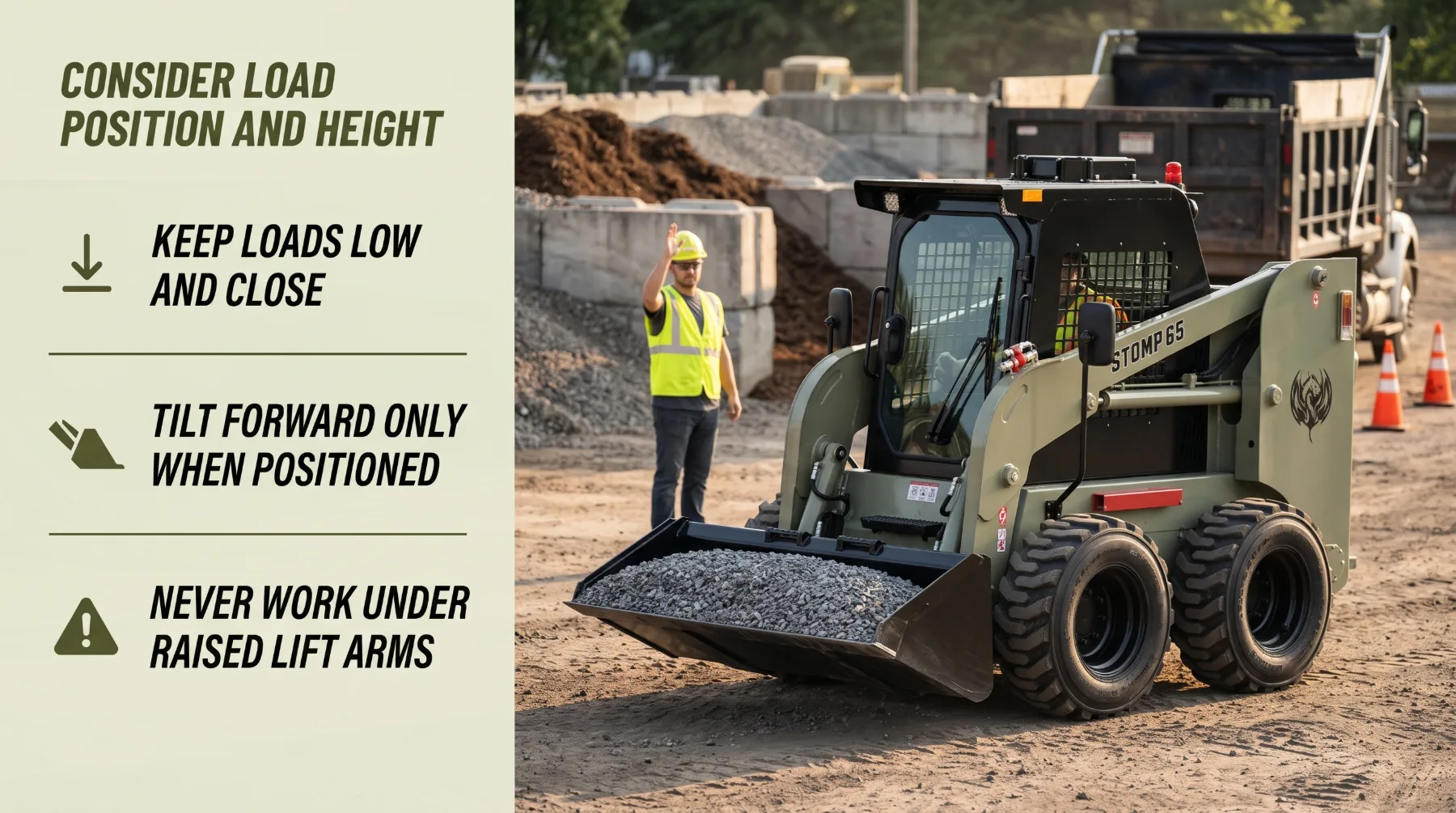
Lift height affects balance in two ways. First, raising the load raises the combined center of gravity of the machine and load, making the loader more sensitive to slopes, bumps, and sudden stops. Second, on many machines, the load moves forward during part of the lift cycle. Radial lift machines move the attachment in an arc around the main pivot, and the load typically reaches its farthest forward point somewhere in the middle of the lift. That mid-lift position is often where the machine is least stable, which is exactly where the operator in the opening story ran into trouble. Vertical lift machines use linkage that keeps the load closer to the machine as it rises, but the load still raises the center of gravity. Review the lift path of your specific machine in the operator's manual.
Tilting forward at height adds further risk. When an operator dumps a bucket or tilts pallet forks forward with the arms raised, the load's center of gravity moves forward and upward at the same time. Dump smoothly, avoid tilting forward with a heavy load until the machine is positioned over the receiving area, and never shake a raised bucket to free sticky material. When placing pallets at height, approach squarely, raise the load only when you're in position, and lower it in a controlled motion.
Travel with the load low. Carrying the attachment just high enough to clear the ground keeps the center of gravity down, preserves visibility, and gives the machine its widest stability margin. Avoid sharp turns, fast acceleration, and hard stops with a loaded attachment, since dynamic forces add to the static load. On slopes, follow the manufacturer's guidance, which commonly calls for traveling straight up and down rather than across, with the heavy end of the machine pointed uphill. With a loaded bucket, that usually means driving forward up a slope and reversing down it. Avoid turning on slopes, and check soft ground, trench edges, and fill slopes before approaching them.
Key takeaway: Loads become less stable as they move forward and upward. Keep loads close to the machine, watch for the least stable point in the lift path, tilt forward only when positioned, travel with loads low, and always wear the seat belt.
Match Capacity to Daily Applications
The right skid steer is the one that handles your regular work comfortably within its rated limits. Buying a machine that only reaches ROC on its best day forces operators to work at the edge of stability, wears components faster, and leaves no margin for uneven ground or heavier-than-expected loads. Matching capacity to daily applications is the most practical way to protect both productivity and safety.
Build in practical margin. Choose a machine whose ROC sits comfortably above your typical working loads rather than one that matches them exactly. That margin absorbs heavier-than-labeled pallets, wet material that weighs more than expected, uneven ground, and the dynamic forces of real operation. It also helps operators work smoothly instead of constantly judging how close they are to the limit. Select a machine that handles regular tasks within its rated limits instead of relying on occasional maximum figures.
Consider site conditions too. Soft ground, slopes, and confined spaces reduce the effective stability margin, even when the load stays within ROC. Compact track loaders often suit soft and uneven terrain, while wheeled skid steers often suit paved and firm surfaces. Measure access widths, gate openings, and trailer limits so the machine you choose can actually reach the work. Check operating weight against the ground conditions and finished surfaces where the machine will travel.
Key takeaway: Choose a loader based on your heaviest regular loads, typical attachments, required lift height, and site conditions, with practical margin above daily needs. Confirm the choice through a realistic demonstration, and train every operator on ROC for each configuration.
Conclusion
Rated operating capacity is an important measure of safe and productive skid steer operation. It indicates how much weight a loader can safely handle under specified conditions and depends on the machine and attachment configuration. Tipping load identifies the point at which the machine becomes unstable, while the rated capacity provides a lower working limit. Attachment weight, load center, and lift height all affect the capacity available for material. Lift arm geometry, hydraulic performance, machine weight, and undercarriage design also influence lifting performance and stability, but operators must always follow the manufacturer's rated limits. Daily inspections should include checking the lift arms, hydraulic hoses, tires or tracks, attachment connections, and safety systems to identify problems that could affect lifting capacity or safe operation. When comparing loaders, consider the materials, loads, attachments, and lifting heights required for your regular work. Review the rated capacity, tipping load, lift height, dump reach, breakout force, and hydraulic specifications for the exact configuration. A practical demonstration with realistic loads can help confirm whether the machine meets job requirements. Ensure operators understand load limits and safe handling procedures. Careful selection and proper operation help improve productivity while protecting workers, property, and equipment.
Frequently Asked Questions
What does rated operating capacity mean?
Rated operating capacity is the manufacturer's rated load limit for a skid steer or compact track loader, established under specified testing and rating procedures such as ISO 14397-1. Under that standard, it is calculated as a percentage of tipping load or 87 percent of hydraulic lift capacity, whichever is lower. The figure applies to a defined configuration, usually with a standard bucket, so heavier attachments or longer load centers reduce the capacity available for material.
Is tipping load the same as rated operating capacity?
No. Tipping load is the weight that causes the rear of the machine to lift off the ground under controlled test conditions, which means the machine has reached its point of instability. Rated operating capacity is the working limit derived from it, set at 50 percent of tipping load for wheeled skid steers and 35 percent for compact track loaders under ISO 14397-1. Tipping load should never be treated as a normal working limit.
Do attachments affect skid steer capacity?
Yes. Attachments add weight at the end of the lift arms, and many hold the load farther forward than a standard bucket. Both effects reduce the net capacity left for material. Check the approved capacity information for each attachment and loader combination, especially for pallet forks, grapples, and heavy-duty buckets, and load by weight rather than by how full the attachment looks.
Should a loader regularly operate at its maximum rating?
Operators should always stay within the manufacturer's limits and consider actual site conditions, load position, lift height, and attachment configuration. Working at ROC on every lift leaves little margin for uneven ground, heavier-than-expected loads, or sudden movements. The best practice is to choose a machine whose rated capacity sits comfortably above your typical daily loads, so operators can work smoothly and safely throughout the shift.