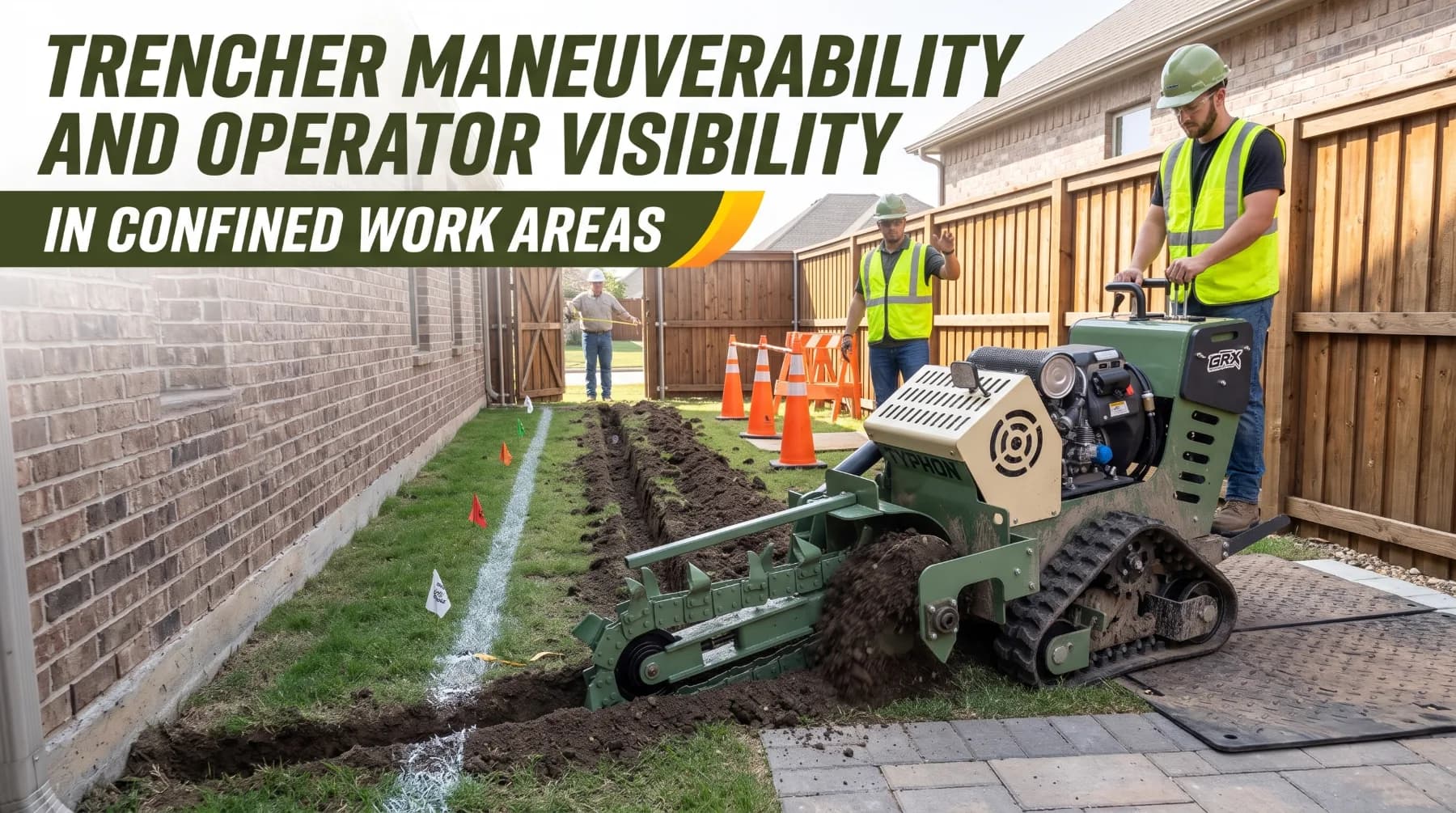
A landscaping contractor is hired to run new irrigation lines and low-voltage lighting cable through a finished backyard. The route passes through a 42-inch side gate, along a narrow strip between the house foundation and a fence, around a corner patio, and between mature trees. The trencher's specification sheet says it is narrow enough for the gate. It does not show how far the boom extends past the fence line during a turn. It also doesn't show how hard it will be to see the chain while the operator cuts beside the foundation. Twenty minutes in, the crew stops. The operator can't see where the chain meets the marked line, and the spoil auger is throwing soil onto the new patio. Every repositioning move takes three attempts.
Trenching in residential developments, urban streets, and restricted construction areas requires equipment that moves accurately through limited space. Maneuverability decides whether a trencher can reach the work, follow the marked line, and reposition without damaging structures or finished surfaces. Operator visibility decides whether the operator can hold cutting alignment and stay aware of nearby workers, structures, and underground services. This guide explains how to evaluate both before you buy or rent, and how to plan and operate for accurate, safe trenching in tight spaces.
Check Overall Machine Dimensions
The first question on any confined site is whether the trencher will fit. Gates, side yards, sidewalks between buildings, alleys, and spaces between parked vehicles set hard limits on what equipment can reach the work. Overall dimensions decide whether a machine passes through those openings. Operating clearance decides whether it can work once it arrives.
Start with width. Measure the narrowest point along the full route, including gate openings, paths between structures, and gaps between stored materials or landscaping features. Compare that measurement with the trencher's widest point, which may be the tracks or tires, the frame, a backfill blade, or the spoil auger housing. Some compact trenchers and ride-on models offer adjustable track width or removable components that reduce width for travel. Confirm whether the machine may operate at its narrowest setting or whether that setting is meant for transit only, since a narrow stance can reduce stability on slopes and uneven ground.
Length matters at corners and turning points. A trencher's overall length includes the boom in its stowed position, and on many machines the boom adds considerable length at one end. A backfill blade, counterweight, or operator platform adds length at the other. A longer machine sweeps a wider path through every turn, even when its width is modest. Measure your tightest corners and repositioning areas, then compare them with the full machine length, not the base frame alone.
Height affects both access and safety. Check stowed height against doorways, carports, eaves, low branches, and overhead structures. Then check the height and reach of the boom when it is raised for travel, since a raised boom can strike eaves, signs, tree limbs, or overhead lines. Note the location of any overhead power lines along the route and at the work area, and keep the clearance distances that applicable regulations and the utility owner require.
Operating clearance is the space the trencher needs to work, not just to sit. Account for room beside the machine for the spoil auger to discharge without hitting walls or finished surfaces. Account for room behind or in front for the boom to lower into the cut, and room for the operator to stand, sit, or walk safely. On a walk-behind or stand-on machine, the operator also needs space to move without being pinned between the machine and a structure. If you need to trench close to a foundation, fence, or curb, look for boom offset or side-shift features that let the chain cut near an obstacle without placing the entire machine against it. Walk the site with a tape measure and the specification sheet for the exact configuration you plan to run, and choose a machine that fits with practical margin rather than one that barely squeezes through.
Key takeaway: Compare the trencher's full width, length, height, and operating clearance with every opening, corner, and work area on site, including space for the boom, spoil discharge, and operator.
Assess the Operator's View
Accurate trenching depends on what the operator can see. In confined areas, the operator has to watch several things at once. The digging chain must stay on the marked line and at the right depth. The spoil discharge must land where intended. The machine must stay clear of structures, and the travel path must stay clear of people and obstacles. Every blind spot increases the risk of a misaligned trench, a damaged surface, or contact with something that should have been avoided.
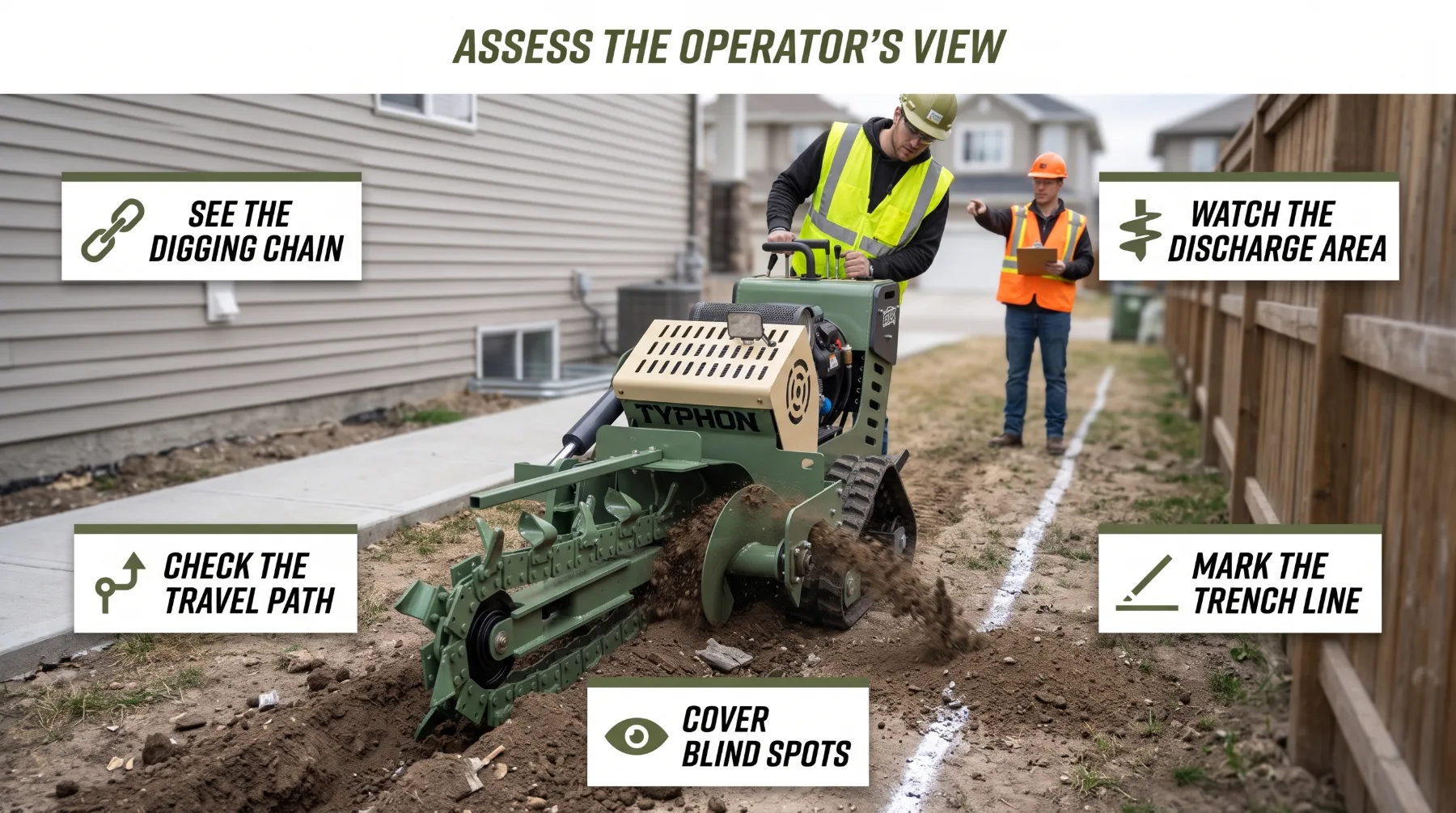
Start with the digging chain. From the normal operating position, the operator should be able to see where the chain enters the ground and how it tracks along the marked route. On many ride-on trenchers, the machine travels away from the cut while the chain digs behind it, so the operator spends much of the job looking rearward. Some models offer seats that rotate or offset to improve that view, along with boom position indicators and depth gauges that the operator can read without leaning out of position. On walk-behind and stand-on machines, check whether the frame, engine housing, or chain guard blocks the line of sight to the cutting point.
The discharge area deserves equal attention. Spoil augers move excavated soil to one side of the trench, and in confined spaces that soil can land on patios, walkways, planting beds, or against foundations if the operator can't see where it goes. Confirm that the operator can see the discharge zone, and check whether the auger can be adjusted or reversed to direct spoil to the preferred side. Keep spoil away from the trench edge and away from areas where it could slide back into the cut.
The travel path completes the picture. The operator needs a clear view of the ground in the direction of travel, including surface changes, edges, holes, valve boxes, and tight clearances near walls, trees, and fences. Check visibility to both sides of the machine and to the rear corners, where structures are most often struck during turns. Assess sightlines from the actual operating position with the boom both raised and lowered, since a raised boom can hide objects at the opposite end of the machine.
Visibility has limits on every machine, and good site practice fills the gaps. Paint the trench line clearly and extend it beyond the ends of the run so the operator can align the machine before cutting. Place stakes or flags at turns and transitions. Use work lights in shaded side yards or under overhangs. Where any part of the work area can't be seen from the operating position, a trained spotter becomes essential.
Key takeaway: Confirm that the operator can see the digging chain, the spoil discharge area, and the travel path from the normal operating position, and use clear line marking, lighting, and spotters to cover remaining blind spots.
Consider Controls and Operating Position
In tight spaces, small control inputs make the difference between a straight trench and one that wanders into a fence line. The control layout and operating position decide how easily the operator makes precise movements while watching the chain, the discharge, and the surroundings. A well-designed station lets the operator focus on the work. A poorly designed one divides attention between finding controls and watching the cut.
Review the travel controls first. The operator should be able to control ground speed and direction smoothly, with fine adjustment at the very slow speeds used while trenching. Many trenchers use hydrostatic drive with a dedicated creep or trenching speed range, which lets the machine advance slowly and steadily while the chain cuts. Check that travel controls respond proportionally and return to neutral when released.
Next, evaluate the digging functions. Chain engagement, chain direction, boom raise and lower, boom offset or side shift, and spoil auger controls should be clearly labeled, logically grouped, and within easy reach from the operating position. The operator should not need to look away from the trench line for long to find a control. Confirm that chain engagement requires a deliberate action and that the chain stops promptly when disengaged. Ask whether the machine includes an operator presence system that stops the chain or travel when the operator leaves the seat or releases the control handle, and tests it during evaluation. Also check whether the trencher's controls and operating position are suitable for the specific job, including residential landscaping, utility installation, or larger commercial trenching projects.
Emergency stops deserve close attention in confined areas. The operator must be able to reach an emergency stop quickly from the normal working position without letting go of the machine or changing stance. On larger machines, check whether additional emergency stops are located where a ground worker can reach them. Confirm what each emergency stop shuts down, and make sure every operator and crew member knows where they are and how they work.
The operating position itself affects comfort, control, and visibility. On ride-on trenchers, check seat adjustment, rotation if available, legroom, and how easily the operator can turn to view the chain without straining. On stand-on machines, check platform size, footing, and handholds. On walk-behind models, check handlebar height and how the operator's position relates to the chain and auger. In every case, the operator should be able to see the work, reach all controls, and maintain a stable stance or seated position at the same time. Ask which visibility aids are available, such as mirrors, cameras, depth indicators, laser receivers, and work lights. Then have your operators test the full control layout through a realistic trenching sequence before you decide.
Key takeaway: Choose a trencher with smooth, clearly labeled travel and digging controls, a reliable operator presence system, emergency stops within immediate reach, and an operating position that supports both control and visibility.
Plan for Workers and Nearby Obstacles
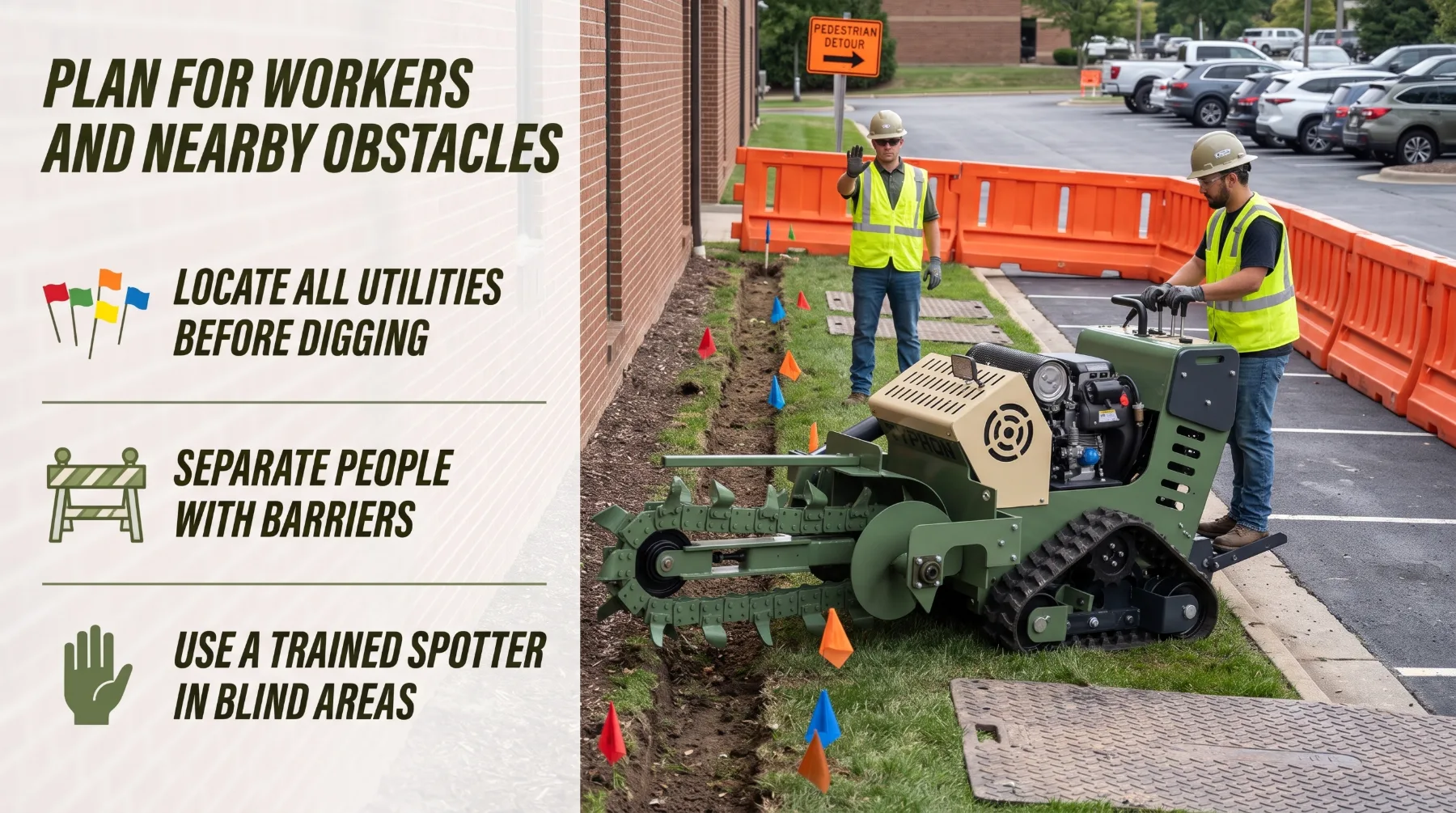
Confined work areas pack hazards into a small space. Walls, fences, foundations, parked vehicles, trees, pedestrians, other machines, and underground utilities may all sit within a few feet of the trench. A trencher chain cuts quickly and can throw rocks and debris, and the machine can strike structures and people during repositioning. Planning the work zone before the first cut protects everyone on site.
Locate underground utilities before any digging. In the United States, contact 811 or your state's one-call center within the required notice period, and wait for every notified utility to mark its lines or confirm it has none in the area. Locate private lines separately, including irrigation, landscape lighting, gas lines to outbuildings, and service connections that one-call locates may not cover. Respect the tolerance zone on each side of every mark, and expose utilities by hand or with approved non-destructive methods before trenching nearby. Stop work and notify the utility owner immediately after any contact with a buried line.
Establish a clear work zone. Mark the trench route, the machine's travel path, turning areas, and the spoil placement area. Set up barriers, cones, or fencing that keep pedestrians and unrelated workers away from the trencher and the open trench. On residential sites, brief homeowners and keep children and pets out of the area. On commercial and urban sites, use rigid barricades and provide a safe alternate route wherever a walkway must close. Keep an exclusion zone around the boom and chain, since rocks and debris can be thrown from the cut. No one should step over, reach near, or stand close to a moving chain. Also check the machine's hydraulic requirements, including the required flow rate and operating pressure, to ensure the hydraulic system can power the trencher attachment properly without exceeding its rated limits.
Protect nearby structures and surfaces. Lay ground protection mats over lawns and finished hardscape along the travel route. Mark obstacles that are hard to see from the operating position, such as valve boxes, low walls, and sprinkler heads. Keep spoil at least 2 feet back from the trench edge, as OSHA requires in the United States, and away from foundations, walkways, and storm drain inlets.
Use a trained spotter when visibility is restricted or site procedures require one. The spotter should stand where both the operator and the hazard area are clearly visible, outside the machine's path and the chain's exclusion zone. Agree on hand signals or radio communication before work begins, and make the stop signal unmistakable. If the operator loses sight of the spotter, the machine must stop until contact is restored. Review the plan with the full crew at the start of each shift, and update it as the trench progresses and conditions change.
Key takeaway: Locate all utilities before digging, mark the trench route and work zone, separate people with barriers and exclusion zones, protect nearby structures, and use a trained spotter wherever visibility is limited.
Operate at a Controlled Speed
In confined areas, speed works against accuracy. A trencher moving too fast leaves the operator less time to correct alignment, react to obstacles, or stop before contact. It also loads the chain unevenly, which produces a rougher trench and faster wear. Controlled speed is one of the simplest and most effective ways to improve both safety and trench quality in tight spaces.
Treat travel speed and cutting speed as separate decisions. When repositioning, raise the boom to its travel position, disengage the chain, and move at a slow, steady pace. Use the machine's low speed range, and slow down further when approaching gates, corners, walls, and people. When trenching, keep chain speed up while adjusting ground speed to the soil. If the chain slows noticeably, the machine is advancing faster than the teeth can cut, so ease back on ground speed and let the chain recover. Forcing the machine forward overloads the chain and drive and makes alignment harder to hold.
Slow down before obstacles, not beside them. Reduce speed as the machine approaches a structure, a utility mark, a surface transition, or a turn. That gives the operator time to check alignment, confirm clearance, and adjust smoothly. Avoid abrupt turns, sudden acceleration, and hard stops, which can shift the machine off line, damage surfaces, and unsettle the operator. Come to a full stop before changing direction.
Ground conditions call for further adjustment. Wet clay, loose gravel, soft turf, and slopes all reduce traction and make the machine harder to control. Follow the manufacturer's guidance for slope operation and surface conditions, travel straight up and down slopes rather than across them where possible, and slow down whenever footing changes.
Stop whenever the route can't be confirmed clearly. If a pedestrian enters the work zone, the spotter signals to stop, the operator loses sight of the spotter, or clearance looks uncertain, the machine should stop until the situation is resolved. If the chain meets unusual resistance or an unexpected obstruction, stop, raise the boom, shut down, and assess before continuing. Finishing a confined job a few minutes faster is never worth a damaged foundation, a cut utility line, or an injured coworker.
Key takeaway: Use slow, steady travel with the chain disengaged during repositioning, match ground speed to cutting conditions, slow down before obstacles, and stop whenever the operator can't confirm that the route is clear.
Conclusion
Trencher maneuverability and operator visibility are essential on confined jobsites. Machine width, length, height, and operating clearance determine whether the equipment can access the work area, while steering design and turning radius affect positioning and repositioning. Clear sightlines to the digging chain, discharge area, and travel path help operators maintain trench accuracy and avoid nearby hazards. Accessible controls, emergency stops, and visibility aids also support safer operation. Evaluate each site by measuring openings, corners, and working areas, then compare those measurements with the trencher’s complete dimensions and turning specifications. Request details about controls and visibility features, and let operators test the machine in an open area. Arrange 811 and private utility locating, then establish a work-zone plan covering barriers, spoil placement, and spotter responsibilities. Careful equipment selection and site planning help crews dig accurately, protect property, and work safely in tight spaces.
Frequently Asked Questions
Why is trencher turning radius important?
Turning radius determines how much space the machine needs to turn, line up on the marked route, and reposition between cuts. In confined areas, check whether the published figure includes the boom and full body, and compare it with your tightest corners while leaving practical clearance.
What should operators be able to see?
Operators should be able to monitor the digging chain, the spoil discharge area, the travel path, and nearby hazards, as far as the machine design permits. Clear line marking, work lights, visibility aids, and trained spotters help cover areas the operator can't see directly.
When should a spotter be used?
Use a trained spotter when visibility is limited, when the machine works or travels close to people, structures, or utilities, or whenever site procedures require one. The machine must stop whenever the operator loses sight of the spotter.
Should operators increase speed to finish a confined job faster?
No. Speed should remain appropriate for visibility, ground conditions, and available clearance. Slow, controlled travel and a ground speed matched to cutting conditions produce more accurate trenches and reduce the risk of damage and injury.