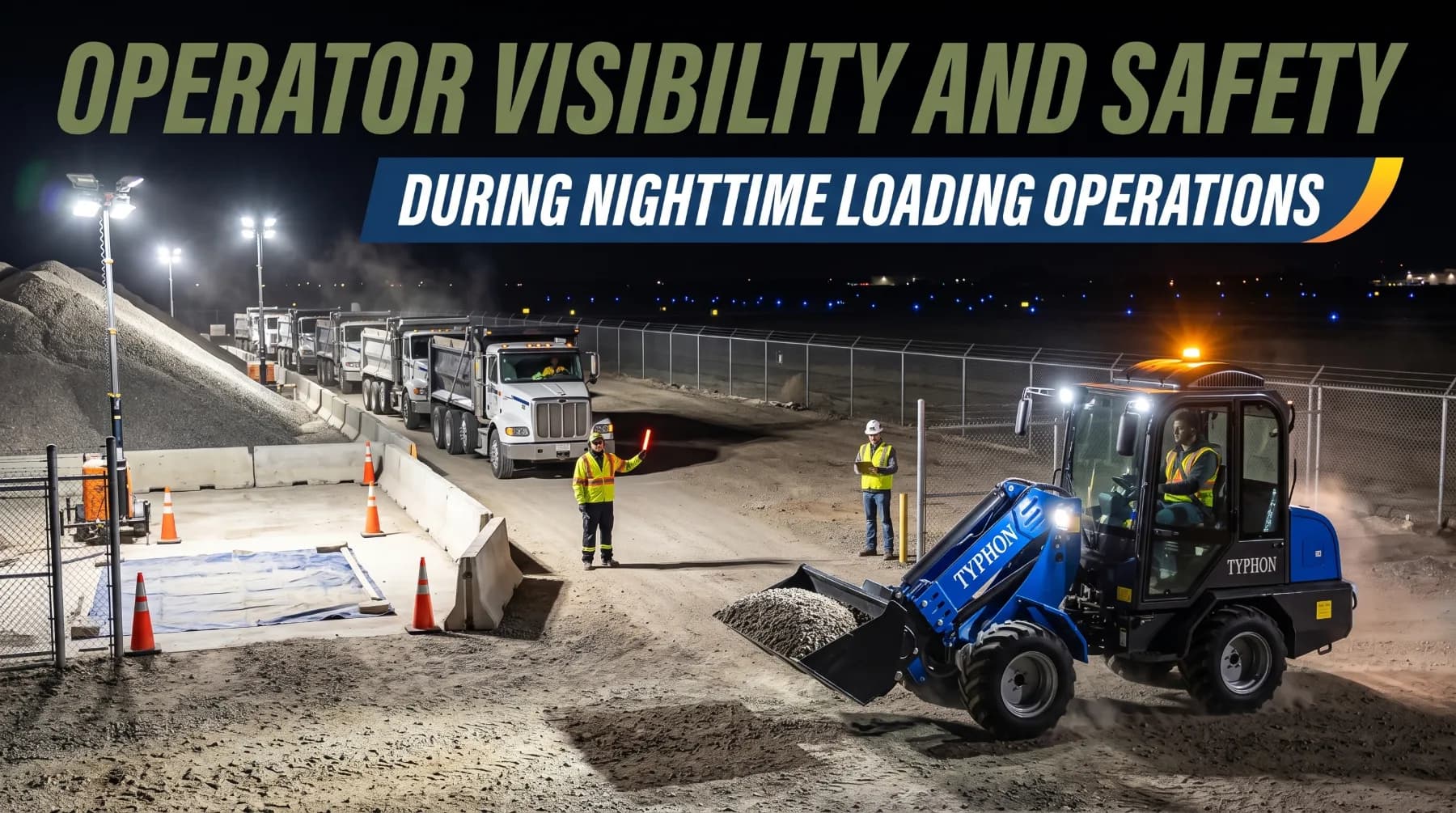
Wheel loaders are essential for moving aggregate, soil, and other bulk materials during nighttime construction and material-handling operations. However, poor lighting, glare, hidden ground hazards, and pedestrian movement can make routine loading tasks dangerous after dark. Maintaining productivity requires a work area where operators can see the stockpile, truck positions, travel routes, and people on foot without losing visibility to harsh or poorly directed lights.
Effective lighting, functioning work lights, clean cameras, audible backup alarms, and clear sightlines all contribute to operator awareness. Uneven surfaces, raised buckets, machine blind spots, and poorly separated vehicle and pedestrian routes add further risks. Fatigue can also reduce reaction time and judgment, making rested operators and reliable communication especially important during extended night shifts.
Safe nighttime loading starts with positioning lights to illuminate work zones while minimizing glare, repairing warning devices, and inspecting equipment before each shift. Crews should separate pedestrian areas from loader and truck movements, use trained spotters when needed, and stop whenever the operator loses sight of a person or vehicle. Low travel speeds, buckets carried close to the ground, clear site rules, and effective fatigue management help maintain safe and efficient operations throughout the night.
Lighting the Work Area
Good nighttime loading starts with light, and the goal is simple. The operator needs to see everything that matters without being blinded by anything. Work areas should have enough light to reveal travel routes, loading points, stockpiles, obstacles, pedestrian crossings, and surface hazards such as ruts, potholes, and spills. Federal construction rules set minimum lighting levels for different work areas, and many contractors light active loading zones well above those minimums. In practice, the test is whether an operator in the cab can clearly see a person, a pothole, and the edge of a truck box from every position the machine will occupy.
How lights are arranged matters as much as how many there are. A single bright source creates hard shadows on the far side of every stockpile, truck, and machine, and those shadows are exactly where people and hazards disappear. Several lights placed around the work area, mounted high and aimed downward, fill those gaps and produce more even coverage. Aim each light onto the work surface rather than toward the operator, truck drivers, or nearby traffic. Glare can be as dangerous as darkness. Light shining into the cab shrinks the operator's pupils, which makes everything outside the beam look darker and hides people standing just beyond it. That's what happened at the airport yard, where the light that helped truck drivers blinded the loader operator.
Fixed lighting systems at warehouses and permanent yards often leave gaps around temporary loading zones, trailer drop areas, and new stockpiles. Portable light towers and work lights can close those gaps, but they need to move as the work moves. When a stockpile shifts, a loading point relocates, or a new truck lane opens, walk the area again after dark and adjust the lights. Lighting that worked at 9 p.m. may leave the new loading point in shadow by midnight.
Light towers bring their own hazards. Place them on firm, level ground, outside the travel paths of trucks and loaders, and protect them with barriers where vehicles pass nearby. Lower the mast and secure the unit when wind picks up, following the manufacturer's instructions. Keep fuel-powered towers away from enclosed spaces. Before raising a mast, look overhead for power lines and maintain the clearance required by applicable regulations. Some sites, such as airports, highways, and residential neighborhoods, also limit how lights can be aimed, so confirm the rules before setting up. A lighting plan that covers placement, aiming, and adjustment points makes the setup repeatable night after night.
Key takeaway: Light travel routes, loading points, and pedestrian areas with several high-mounted lights aimed down onto the work, keep glare out of operators' and drivers' eyes, and adjust portable lights whenever the work area changes.
Machine Lights and Warning Systems
Site lighting shows the operator the yard. Machine lights and warning devices do two more jobs. They light the area right around the machine, and they make the machine visible to everyone else. Headlights and forward work lights illuminate the travel path and the bucket or forks. Rear work lights show the ground behind the machine during every reverse. Tail lights, beacons, and strobe lights tell others where the machine is and which way it's moving. Backup alarms and horns warn people who can't see the machine at all. Together, these systems give the operator a better view and give the people nearby a better chance to stay clear.
Each system only helps when it works and stays clean. Mud, dust, snow, and frost can cut a work light's output dramatically, and a lens coated with grime scatters light in ways that add glare. A backup alarm packed with dried mud may sound half as loud as it should, and a beacon hidden behind a raised attachment does little good. Operators should inspect every light and warning device before starting a nighttime shift. Walk around the machine with the lights on, confirm that each one works, and clean every lens. Sound the horn, and check that the backup alarm can be heard clearly above the noise of the yard. Many machines also offer adjustable work lights, so aim them to light the ground in front of and behind the machine rather than straight out at trucks or other operators.
Any required light or warning device that isn't working should be repaired before the machine enters active work areas. A failed rear work light or a weak alarm can seem minor at the start of a busy night. However, these are the systems that stand between a reversing machine and a person walking behind it. Report the defect, tag the machine if site rules require it, and keep it out of the loading zone until a qualified technician makes the repair. Carrying spare bulbs or a backup light kit on night jobs keeps small failures from stopping production.
Warning devices support good practices but never replace them. A beacon or alarm tells people that a machine is moving. It doesn't tell the operator that someone has stepped into its path. Use the horn according to site rules, especially before starting to move and at blind corners. Never disable or muffle a backup alarm to reduce noise complaints. If noise limits apply near homes or businesses, work with the site owner on approved alternatives, such as broadband alarms, rather than removing warnings.
Key takeaway: Inspect and clean headlights, work lights, tail lights, beacons, horns, and backup alarms before every nighttime shift, and repair any failed light or warning device before the machine enters an active work area.
Managing Blind Spots
Darkness increases blind spots around loading machines and makes it harder to identify nearby workers, vehicles, and obstacles. Proper visibility checks, careful movement, and clear communication help reduce the risk of collisions during night operations.
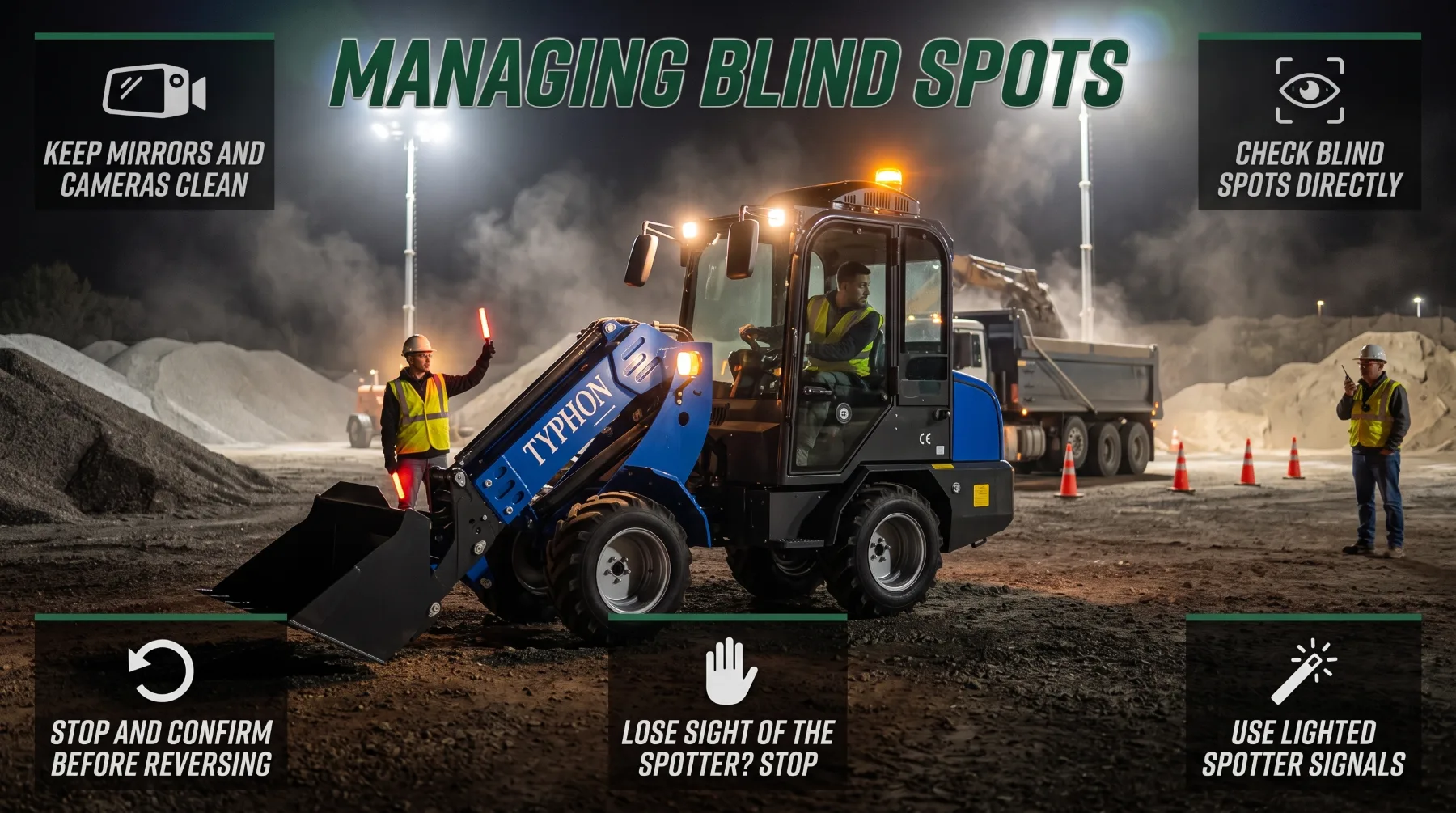
Identify Blind Spots: Understand how the engine compartment, counterweight, cab posts, loader arms, and raised loads block visibility. Pay extra attention to areas around the rear tires and machine corners.
Check Mirrors and Cameras: Keep mirrors and camera lenses clean and understand their limitations. Glare, shadows, dirt, and wet lenses can reduce visibility, while detection systems may not identify every obstacle.
Check Before Moving: Look in the direction of travel and scan mirrors, cameras, and areas outside their view. Stop and confirm the path is clear before reversing when visibility is uncertain.
Use a Trained Spotter: When visibility is limited, use a trained spotter with agreed hand signals or illuminated wands. The spotter must remain visible and outside the machine's travel path and surrounding hazard areas.
Maintain Clear Communication: Agree on signals and radio procedures before starting work. If the operator loses sight of the spotter, stop immediately and wait until visual contact is restored.
Key takeaway: Know the limits of your machine's mirrors, cameras, and detection systems, check blind spots directly before every move, and use a trained spotter with lighted signals who stays visible to the operator whenever nighttime visibility is inadequate.
Protecting Pedestrians and Ground Crews
The safest way to protect people on foot is to keep them away from moving equipment. At night, that principle matters even more, because the operator's ability to see and react drops sharply. Pedestrians should be separated from loading routes wherever possible through barriers, designated walkways, and controlled access points. Concrete barriers, fencing, and cone lines can define where machines operate and where people walk. Mark pedestrian crossings clearly, light them well, and place them where operators can see them from a distance.
Truck drivers need special attention, because they enter the loading area all night long and often aren't part of the loading crew. Set clear rules before the first truck arrives. Many sites require drivers to stay in their cabs during loading, or to remain in a designated, protected waiting area when they must step out. Tasks such as tarping, checking tailgates, and adjusting loads should happen in a lighted area away from the loading zone. Give drivers a way to communicate with the operator by radio, and make sure the operator always knows when someone leaves a cab. The near miss at the airport yard happened because a driver had no safe place to tarp and no rule telling him to call the loader first.
Workers must remain clear of suspended and raised loads at all times. No one should stand or walk beneath a raised bucket, raised forks, or a load being placed into a truck box or onto a rack. Ground crew members should also avoid approaching equipment unexpectedly. Anyone who needs to reach a machine should make eye contact with the operator, signal clearly, and wait until the operator stops the machine and lowers the attachment before moving closer. Establish a work zone around each loading point and keep people outside it while the machine is working.
High-visibility clothing and good lighting can improve detection, but they don't replace separation and communication. Retroreflective garments shine brightly in headlights and work lights, yet they show up only when light hits them and the operator is looking in the right direction. Choose garments suited to nighttime work. Higher-visibility classes are often required near traffic and moving equipment after dark. Replace vests and jackets when they become faded, dirty, or torn, since worn reflective material loses much of its effect. Treat high-visibility clothing as one layer of protection among several, not as permission to walk into active loading areas.
Key takeaway: Separate pedestrians from loading routes with barriers, walkways, and controlled access, set clear rules for truck drivers, keep everyone away from raised loads, and treat high-visibility clothing as a support for separation and communication rather than a substitute.
Pre-Shift Checks and Fatigue Management
Nighttime loading begins before the first machine moves. A thorough pre-shift inspection confirms that the machine is ready for low-light work. Before starting, operators should inspect lights, brakes, steering, alarms, mirrors, cameras, and other safety systems. Many inspection routines happen in daylight, but night shifts need their own check. A light that worked yesterday afternoon may fail tonight, and a camera that looked fine in sunlight may be useless under light towers. Walk around the machine with every light on, clean the windows, mirrors, and camera lenses, and confirm that the cab glass is free of film and glare. Test the brakes and steering in a clear, well-lit area, check the horn and backup alarm, and make sure the seat belt latches securely. Record the results and report any defect before work begins.
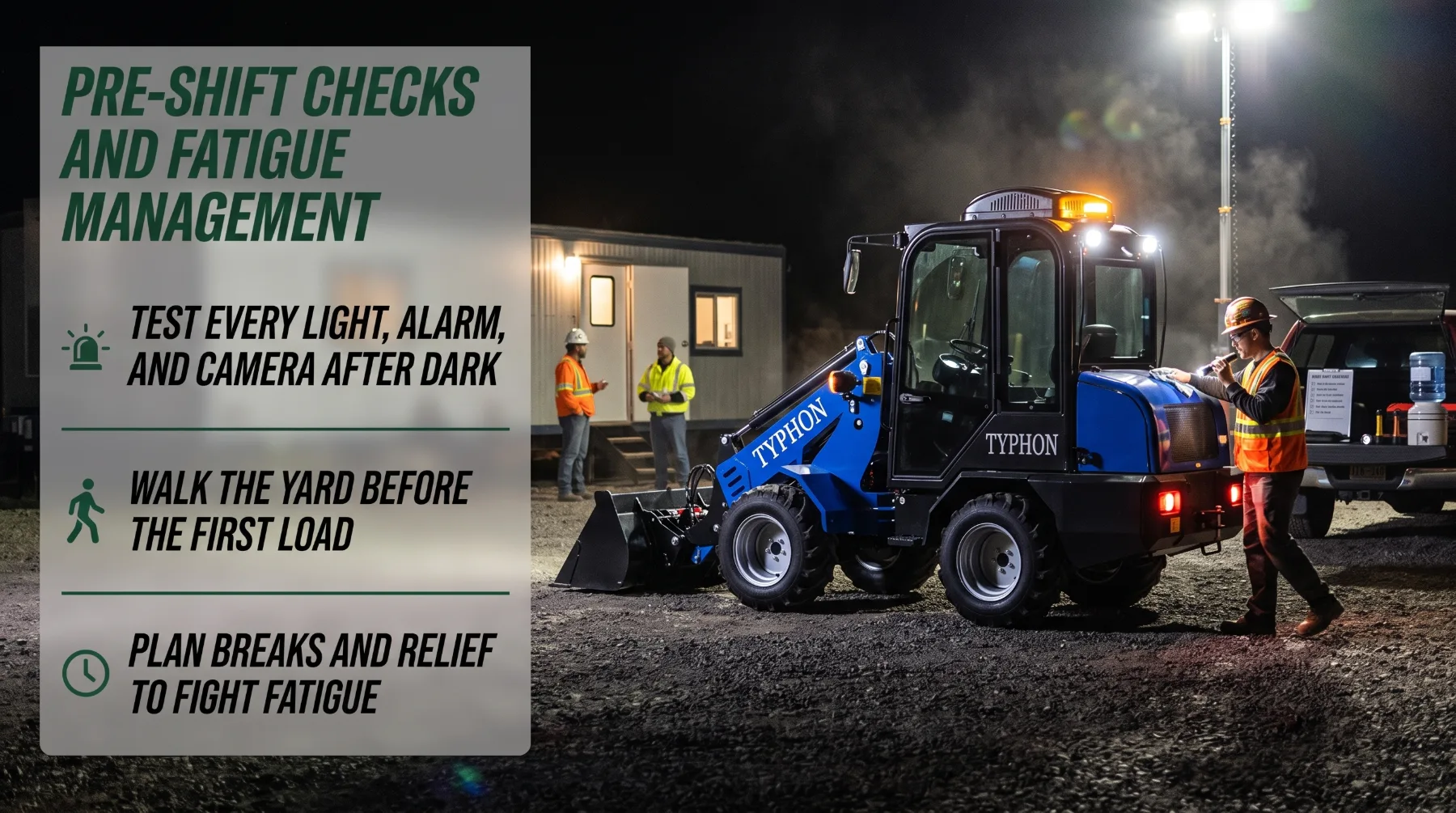
The work area needs a pre-shift check as well. Walk the yard after dark, ideally with the lights already set up. Look for shadows, glare, potholes, spills, and changes since the last shift, and confirm that barriers, walkways, and driver waiting areas are in place. Hold a short briefing with the operator, spotters, ground crew, and the trucking dispatcher. Cover traffic patterns, communication methods, signals, and any hazards on the site that night.
Fatigue is one of the most serious and least visible hazards in nighttime work. The human body naturally wants to sleep at night, and alertness often dips in the early morning hours, sometimes between about 2 a.m. and 6 a.m. A tired operator reacts more slowly, misjudges distances more often, and may miss a person stepping into view. Supervisors should consider fatigue, shift length, breaks, and workload when assigning tasks. Avoid scheduling operators for a full day shift followed by a night shift, as happened at the airport yard. Provide regular breaks where operators can leave the cab, stretch, walk, and drink water. Where long night operations are planned, rotate operators or bring in relief so no one runs the machine for extended stretches without rest.
Operators share responsibility for their own alertness. Arrive rested, and speak up when fatigue sets in. Equipment operators must report visibility problems, such as failed lights, glare, dirty cameras, or poorly lit areas, and shouldn't continue when conditions prevent safe control. The same goes for fatigue. An operator who notices drifting attention, heavy eyelids, or slowed reactions should stop and tell a supervisor. A short break or a relief operator costs far less than an incident. A site culture that welcomes those reports, rather than pushing through them, keeps everyone safer through the night.
Key takeaway: Inspect lights, brakes, steering, alarms, mirrors, cameras, and safety systems before every night shift, walk the work area after dark, plan shifts and breaks to manage fatigue, and stop work whenever visibility or alertness prevents safe control.
Conclusion
Safe nighttime loading depends on adequate lighting, functioning warning systems, pedestrian separation, and controlled machine movement, supported by alert and well-prepared operators. Properly positioned light towers should illuminate travel routes, loading points, and surrounding hazards while minimizing glare for operators and truck drivers. Clean, working headlights, work lights, beacons, mirrors, windows, and camera lenses improve visibility, while horns, backup alarms, brakes, steering, and object detection systems should be checked before work begins. Operators must understand the limitations of mirrors and cameras, check blind spots directly where possible, and use a trained spotter with lighted signals when visibility is restricted. Barriers, designated pedestrian walkways, clear driver waiting areas, and clean, undamaged high-visibility clothing help separate people from moving equipment. Before each shift, walk the work area after dark to identify shadows, glare, potholes, spills, and changes in ground conditions. Position light towers on firm ground outside travel paths, aim them toward the work, and keep glare away from operators. Brief truck drivers on site rules, radio communication, and designated tarping areas, and establish a clear stop signal with the spotter. Operators should follow posted speed limits, carry loads low during travel, and adjust speed to the visible distance and ground conditions. Regular pre-shift inspections, planned breaks, and appropriate relief for extended shifts help manage fatigue and maintain attention. Combining effective lighting, reliable warning systems, clear communication, and disciplined operating practices helps protect workers and drivers while supporting accurate, efficient nighttime loading.
Frequently Asked Questions
Why is nighttime loading more hazardous?
Reduced visibility makes it harder to spot pedestrians, judge distances, and identify obstacles or surface hazards. Shadows can hide people and potholes, glare can blind operators, and natural fatigue during overnight hours slows reaction time. Good lighting, working warning systems, pedestrian separation, and fatigue management help offset these risks.
What lighting is needed for nighttime loading?
Lighting should clearly illuminate travel paths, loading areas, pedestrian routes, and potential hazards without creating excessive glare. Use several high-mounted lights aimed down onto the work rather than one bright source, keep light out of operators' and drivers' eyes, meet applicable minimum lighting requirements, and adjust portable lights whenever the work area changes.
Can cameras eliminate equipment blind spots?
No. Cameras can improve awareness, but they have limited fields of view and can wash out in glare, go dark in shadow, or blur when lenses get dirty or wet. Operators must still check their surroundings directly, keep lenses clean, and follow safe travel procedures, especially before reversing.
When should a spotter be used?
A trained spotter should be used when site procedures require one or when visibility isn't sufficient for safe movement without assistance. At night, the spotter should use lighted wands or illuminated signals, stay in the operator's view and outside the machine's path, and agree on signals in advance. The operator should stop immediately if the spotter disappears from view.