Best Skid Steer for Landscaping: A Complete Buying Guide
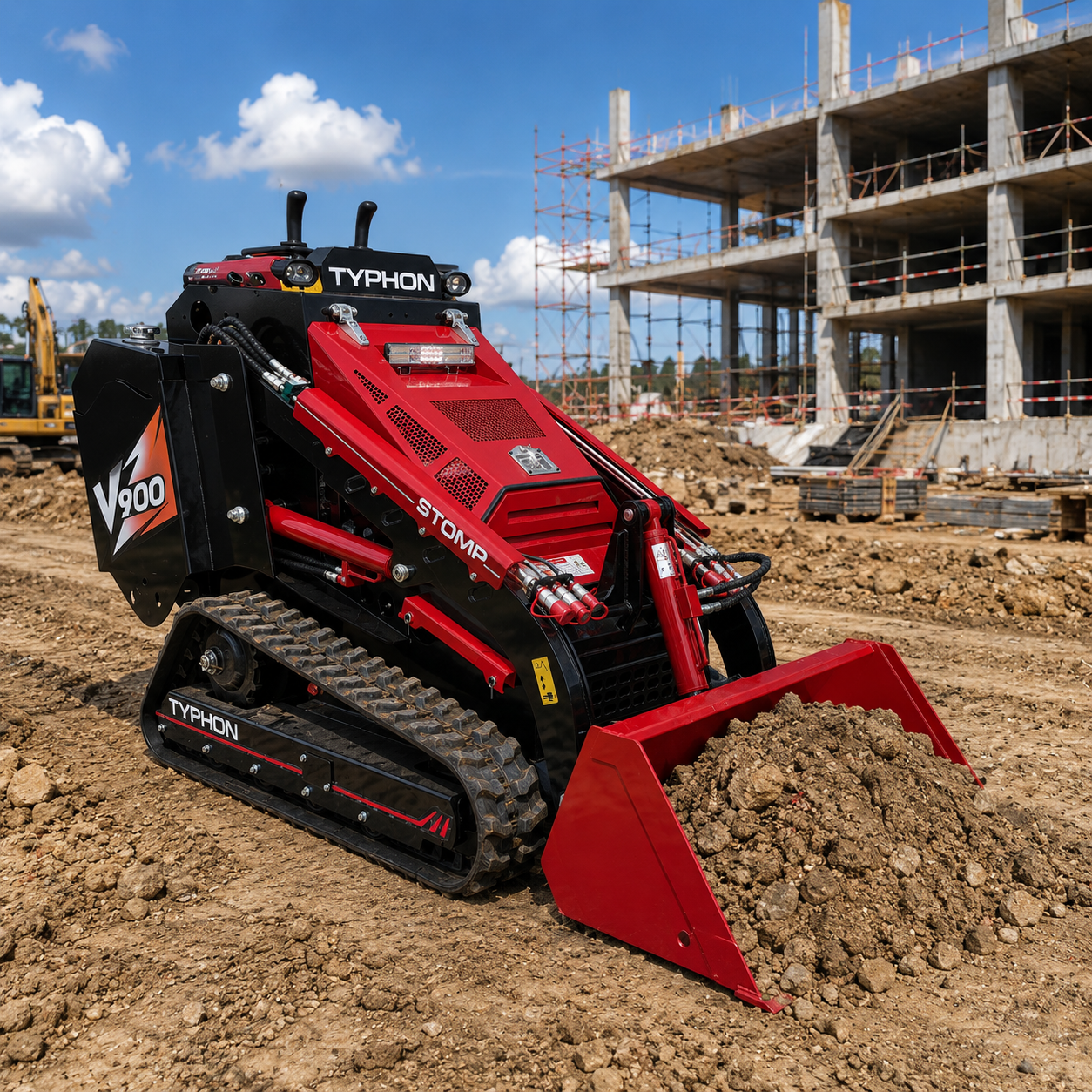
Landscaping projects often involve much more than moving a small amount of soil. Contractors may need to excavate planting areas, transport mulch, grade uneven ground, install drainage, drill post holes, remove brush and prepare new lawns—all within the same jobsite.
A skid steer loader can handle many of these tasks with one compact machine and a selection of interchangeable attachments. However, choosing the best skid steer for landscaping requires more than comparing engine horsepower.
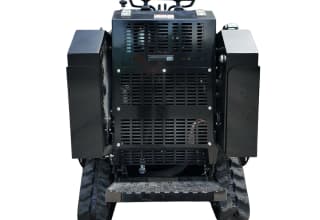
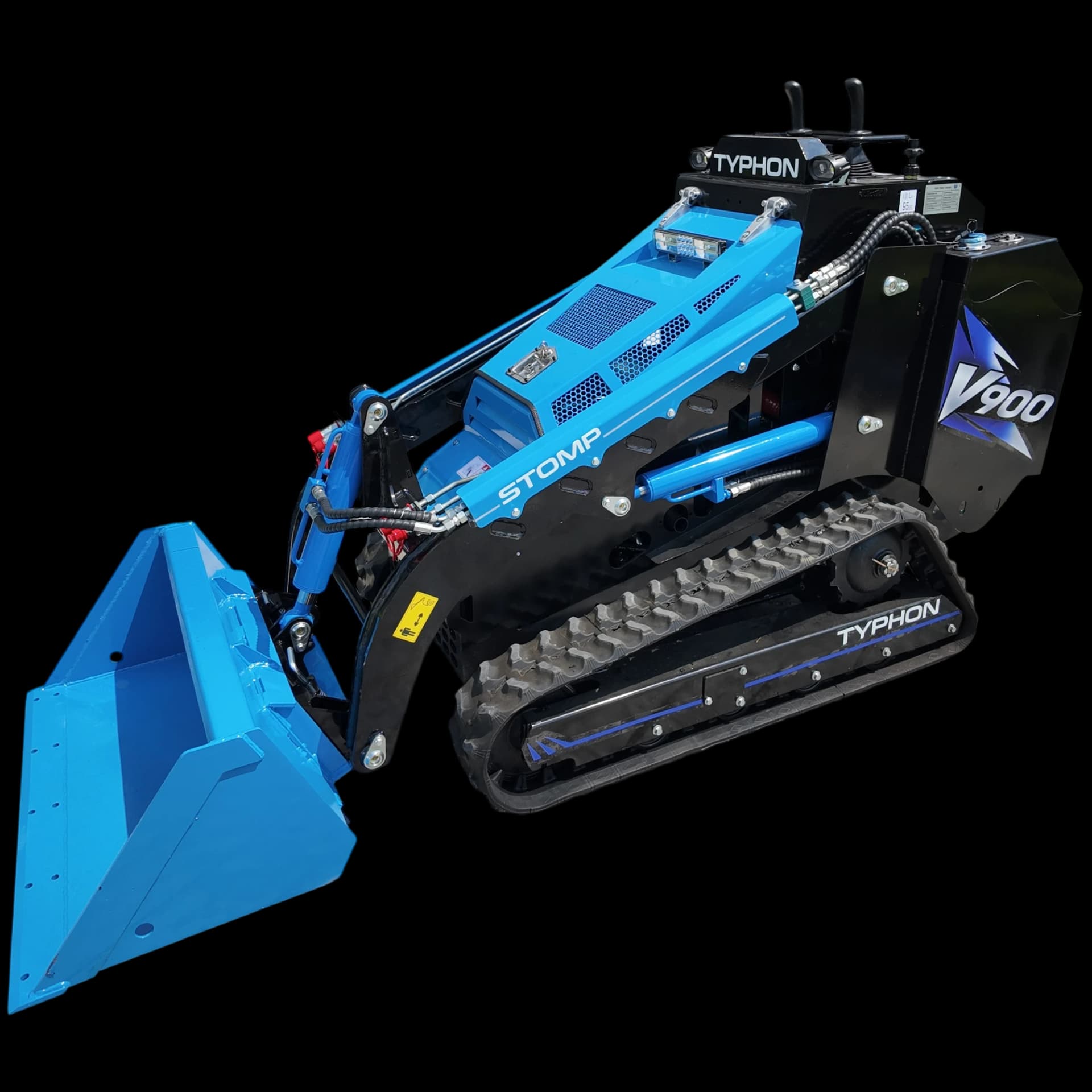
The right machine should combine compact dimensions, reliable hydraulic performance, ground stability, attachment compatibility and precise operator control. For residential landscaping, property maintenance and confined outdoor projects, a compact tracked model such as the TYPHON STOMP V900 skid steer loader can provide an effective balance between maneuverability and jobsite capability.
Why Skid Steers Are Valuable for Landscaping
A landscaping crew may otherwise need several separate machines to complete excavation, grading, material handling and site-cleanup work. A skid steer reduces this equipment requirement by using a universal loader platform with different attachments.
Depending on its configuration, a landscaping skid steer can be used to:
- Move soil, gravel, mulch and compost
- Grade yards and prepare lawns
- Excavate shallow foundations
- Dig drainage channels
- Drill holes for trees, fences and retaining walls
- Remove shrubs, roots and jobsite debris
- Carry pallets, plants and landscaping materials
- Prepare driveways and pathways
- Clear snow from properties
- Load trailers and dump containers
This versatility can reduce manual labor and help a landscaping company complete more work without transporting multiple dedicated machines.
What Is the Best Skid Steer for Landscaping?
There is no single skid steer that is perfect for every landscaping company. The best model depends on the size of the properties, ground conditions, required attachments and weight of the materials being handled.
For most residential and light-commercial landscaping projects, the ideal machine should have:
- Compact overall dimensions
- Tracks for improved ground contact
- Sufficient hydraulic flow for attachments
- Responsive operating controls
- Good visibility around the machine
- Easy attachment changes
- A reliable engine
- A practical lifting capacity
- Easy transportation between projects
A large skid steer may provide greater lifting capacity, but it can also be difficult to transport and operate around homes, fences, gardens and finished landscaping. A compact tracked skid steer can often provide better access while still offering the power required for common landscaping jobs.
Wheeled vs. Tracked Skid Steers for Landscaping
One of the first decisions is whether to choose a wheeled or tracked machine.
Wheeled skid steers
Wheeled skid steers generally perform well on hard, dry and level surfaces. They can travel efficiently across pavement and may have lower undercarriage maintenance requirements.
They are commonly used for:
- Paved commercial properties
- Warehouses
- Material yards
- Hard-packed construction sites
- Street and parking-area maintenance
However, wheels can lose traction or create deeper ruts when working on soft soil, mud or recently prepared lawns.
Tracked skid steers
Tracked skid steers distribute machine weight over a larger ground-contact area. This can provide better traction and stability on loose, uneven or soft surfaces.
They are often better suited for:
- Residential yards
- Muddy jobsites
- Loose soil
- Sloped landscaping areas
- Farms and orchards
- New lawn preparation
- Property-maintenance work
For contractors who frequently work away from pavement, a tracked skid steer is generally the more versatile landscaping choice.
Why Compact Size Matters
Landscaping jobs frequently take place in restricted areas. A machine may need to pass through gates, travel between buildings, work beside swimming pools or maneuver around trees and finished structures.
A compact skid steer can access areas where a full-size machine may be impractical. Its smaller footprint can also make it easier to:
- Work near houses and retaining walls
- Operate between rows of trees
- Enter residential backyards
- Navigate narrow pathways
- Load onto a suitable equipment trailer
- Work around existing gardens
- Reduce disturbance to the surrounding property
Compact size should not be confused with limited capability. A properly configured mini skid steer can operate buckets, augers, trenchers, grapples, pallet forks and other hydraulic tools.
TYPHON STOMP V900: A Compact Choice for Landscaping
The TYPHON STOMP V900 skid steer loader is designed for jobs where working space is limited but dependable machinery performance is still required.
Its compact tracked platform makes it suitable for residential landscaping, farms, orchards, property maintenance and confined jobsites. It can move through working areas that may be difficult for a conventional full-size skid steer to access.
The V900 configuration uses a Kubota D1105 three-cylinder diesel engine. Kubota describes the D1105 series as a vertical, water-cooled, four-cycle diesel platform with a displacement of approximately 68.5 cubic inches. Exact output and emissions specifications vary by engine version, so the machine’s final product specifications should always be confirmed before publication or purchase.
Key landscaping advantages of the V900
Compact maneuverability
The V900 can work around residential properties, garden areas, paths and other restricted spaces where a larger loader may be difficult to position.
Tracked undercarriage
Its tracked design provides stable ground contact for loose soil, gravel, uneven terrain and soft landscaping surfaces.
Diesel-powered performance
A diesel configuration is well suited to contractors who require consistent working power throughout repeated loading, grading and attachment operations.
Hydraulic attachment capability
The V900 can be paired with compatible hydraulic attachments for digging, trenching, drilling, gripping and material-handling work.
Multiple jobsite applications
Instead of purchasing a separate machine for every task, contractors can configure the V900 for different stages of a landscaping project.
The broader TYPHON STOMP range is marketed for compact construction and outdoor applications where maneuverability is important.
Best Landscaping Attachments for the TYPHON STOMP V900
The attachment is often just as important as the skid steer itself. Before purchasing any tool, confirm the attachment plate, hydraulic connection, required flow, operating pressure and machine lifting limits.
General-purpose bucket
A standard bucket is one of the most frequently used landscaping attachments.
It can be used to:
- Move topsoil
- Carry mulch
- Load gravel
- Remove loose debris
- Spread compost
- Back-drag soil
- Fill low areas
A bucket with a durable cutting edge is useful when digging into compacted material or repeatedly working against abrasive surfaces.
Four-in-one bucket
A four-in-one bucket combines several functions in one attachment. Depending on its design, it can operate as a standard bucket, grading blade, clamshell and light grapple.
It is useful for:
- Grading soil
- Picking up branches
- Back-dragging
- Spreading material
- Carrying loose debris
- Cleaning finished areas
This can be a practical attachment for contractors who want additional versatility without changing tools as frequently.
Auger attachment
An auger converts the skid steer into a powered drilling machine.
Common landscaping applications include:
- Fence-post installation
- Tree planting
- Sign installation
- Deck foundations
- Pergola construction
- Retaining-wall posts
Different auger-bit diameters can be selected according to the required hole size and ground conditions.
Trencher attachment
A trencher creates narrow, controlled channels with less surface disturbance than broad bucket excavation.
It can help install:
- Irrigation lines
- Landscape lighting cables
- Drainage pipes
- Utility conduits
- Sprinkler systems
- Property-boundary wiring
The required trench depth, width and soil type should be considered when choosing a trencher chain.
Grapple attachment
A grapple provides improved control when handling irregular landscaping materials.
It is useful for moving:
- Tree branches
- Brush
- Roots
- Logs
- Rocks
- Demolition debris
- Storm-cleanup material
A grapple can significantly reduce manual handling during land clearing and property cleanup.
Pallet forks
Pallet forks allow the skid steer to lift and transport palletized materials.
Landscapers can use them for:
- Pavers
- Bagged soil
- Sod
- Retaining-wall blocks
- Plants and trees
- Fencing materials
- Fertilizer
- Equipment and tools
Always keep loads within the machine’s rated operating and attachment limits.
Rake or soil-preparation attachment
A landscape rake can collect stones, remove debris and prepare soil before seeding.
Depending on the attachment, it may be used for:
- Lawn renovation
- Seedbed preparation
- Rock removal
- Surface leveling
- Soil conditioning
- Final site cleanup
Snow-removal attachment
Landscaping businesses can expand into seasonal property maintenance by adding a snow blade, bucket or compatible snow-removal attachment.
This allows the machine to remain productive during winter instead of sitting unused between landscaping seasons.
Important Features to Compare
Hydraulic performance
Hydraulic flow determines which powered attachments a skid steer can operate effectively. A machine intended only for bucket work may require less flow than one expected to power trenchers, mowers or other demanding attachments.
Before choosing a machine, compare:
- Main hydraulic flow
- Auxiliary hydraulic flow
- Working pressure
- Hydraulic connection type
- Attachment manufacturer requirements
Never assume that every hydraulic attachment will work correctly simply because it fits the mounting plate.
Lifting capacity
Consider the materials the machine must handle rather than selecting a capacity based only on the heaviest possible load.
Landscaping loads may include:
- Wet soil
- Gravel
- Large rocks
- Pallets of pavers
- Mature trees
- Retaining-wall blocks
- Logs and brush
Wet material can weigh considerably more than dry material. The attachment’s weight must also be included when evaluating the total working load.
Lift path
A vertical-lift design generally keeps the load closer to the machine through more of the lifting cycle and can be helpful when loading trucks or placing materials at height.
A radial-lift design may be suitable for digging, grading and lower-height loading. Contractors should select the lift geometry that matches their most common work.
Machine width
Measure the narrowest gates, paths and access points on typical jobsites. The machine must fit through the available space with the selected attachment installed.
Do not compare only the chassis width. Buckets, tracks and other components may determine the machine’s actual working width.
Operating weight
A heavier skid steer may offer improved stability, but it also requires a suitable trailer, tow vehicle and loading system.
Account for:
- Machine operating weight
- Attachment weight
- Fuel
- Additional tools
- Trailer capacity
- Tow-vehicle rating
- Local transportation requirements
Operator controls
Responsive controls are important for precise grading and safe material placement.
The operator should be able to control:
- Travel speed
- Direction
- Lift-arm movement
- Bucket angle
- Auxiliary hydraulics
- Attachment operation
Smooth control is especially important around homes, fences, utility lines and finished surfaces.
Landscaping Jobs the V900 Can Support
With a suitable attachment, the TYPHON STOMP V900 can support several stages of a landscaping project.
Site preparation
The machine can clear loose debris, remove surface vegetation and prepare an area before construction or planting begins.
Soil and mulch movement
A bucket can transport soil, compost, mulch and gravel around a property more efficiently than manual carts or wheelbarrows.
Yard grading
Controlled bucket movements allow operators to redistribute soil, fill low areas and prepare a more consistent surface.
Drainage installation
A trencher or narrow bucket can create channels for drainage lines and irrigation systems.
Tree and fence installation
An auger can drill consistent holes for posts, trees and landscape structures.
Material placement
Pallet forks can transport pavers, blocks, sod and bagged materials closer to the installation area.
Property cleanup
A grapple can collect storm debris, branches, brush and other irregular material.
How to Reduce Ground Damage
Even a tracked machine can disturb soft ground when operated aggressively. Contractors can reduce surface damage by:
- Avoiding sharp counter-rotation on finished lawns
- Using gradual turns
- Planning travel routes before work begins
- Avoiding saturated ground when possible
- Using ground-protection mats near sensitive areas
- Keeping unnecessary machine travel to a minimum
- Selecting the correct attachment for the task
- Removing excess material from the tracks
Good operating technique is as important as machine size when protecting an existing landscape.
Is a Mini Skid Steer Better Than a Full-Size Skid Steer?
A mini skid steer may be the better choice when:
- Most projects are residential
- Access points are narrow
- Ground disturbance must be limited
- The machine must be transported frequently
- The work involves moderate loads
- Attachment versatility is more important than maximum capacity
A full-size skid steer may be more appropriate when:
- Heavy pallets must be lifted regularly
- Large quantities of material must be moved
- Trucks need to be loaded at greater height
- The jobsite has wide access
- High-capacity attachments are required
Many landscaping businesses benefit from a compact machine because it can enter more properties and complete a wider variety of smaller projects.
Questions to Ask Before Buying
Before selecting a landscaping skid steer, ask:
- What is the narrowest access point on our typical jobsite?
- What materials will we lift most frequently?
- Which attachments will we use immediately?
- What hydraulic flow do those attachments require?
- Can our current truck and trailer transport the machine safely?
- Are replacement parts and service support available?
- How easy is routine maintenance?
- Will the machine work on soft and uneven terrain?
- Can operators control it precisely around finished properties?
- Can the machine support additional services as the business grows?
Final Verdict: Is the TYPHON STOMP V900 Good for Landscaping?
The best skid steer for landscaping should be compact enough to enter restricted properties, stable enough for uneven terrain and versatile enough to operate multiple attachments.
The TYPHON STOMP V900 skid steer loader is a strong option for contractors, landowners and property-maintenance teams that need a compact tracked machine for soil movement, grading, trenching, drilling, material handling and cleanup work.
Its value is not limited to one landscaping task. By changing attachments, the V900 can support several stages of a project—from initial site preparation to final cleanup.
Before purchasing, confirm the latest machine specifications, attachment compatibility, rated capacity, transportation requirements and available service support.
Explore the TYPHON STOMP V900 and find the right attachment package for your next landscaping project.
Explore Skid Steer Attachments
Frequently Asked Questions
What size skid steer is best for residential landscaping?
A compact or mini skid steer is often suitable for residential landscaping because it can travel through restricted access points and work around buildings, gardens and other existing structures.
Are tracks or wheels better for landscaping?
Tracks are generally more suitable for soft soil, mud, loose gravel and uneven ground. Wheels may be more efficient on hard, paved surfaces.
Can a skid steer grade a yard?
Yes. A skid steer equipped with the correct bucket, grading attachment or soil-preparation tool can redistribute soil, fill low areas and prepare a yard for seeding or sod installation.
Can the TYPHON STOMP V900 use landscaping attachments?
The V900 is designed as a multipurpose compact loader. Attachment compatibility should be confirmed according to the mounting system, hydraulic flow, connection type, attachment weight and operating requirements.
What attachments should a landscaping company buy first?
A general-purpose bucket, pallet forks, auger, trencher and grapple provide a strong starting combination for many landscaping businesses.
Can a skid steer install irrigation lines?
Yes. A compatible trencher attachment can create narrow trenches for irrigation pipes, sprinkler systems, drainage lines and landscape-lighting cables.
Can a skid steer remove trees?
A skid steer can help remove small trees, brush and roots using appropriate attachments. Large-tree removal requires professional planning, properly rated equipment and safe work procedures.
Is a compact skid steer easy to transport?
Compact machines are generally easier to transport than full-size loaders, but the combined weight of the machine, attachment, trailer and equipment must remain within all applicable towing and trailer ratings.